
86 13686388557

Date:2026-10-09
A grounded look at where RC slope mowers take over, where they do not, and how to make the call without betting the fleet
On a Tuesday morning in late May, a two-person crew pulls up to a 32-degree grass embankment beside a county road. In years past, one of them would have clipped on a harness, tied off to a truck bumper, and walked a line trimmer down the face of the slope. Today, the same two people stay on level ground. One sets up cones and a spotter position; the other picks up a transmitter. Eight minutes later the slope is cut, the blades disengage the moment the trigger is released, and nobody set foot on the grade.
That scene is real on a growing number of contractor and municipal routes. It also explains why the question is no longer "is remote control (RC) mowing a gadget?" but a sharper one: which of my existing machines can it actually replace, and where would swapping one in create a new problem?
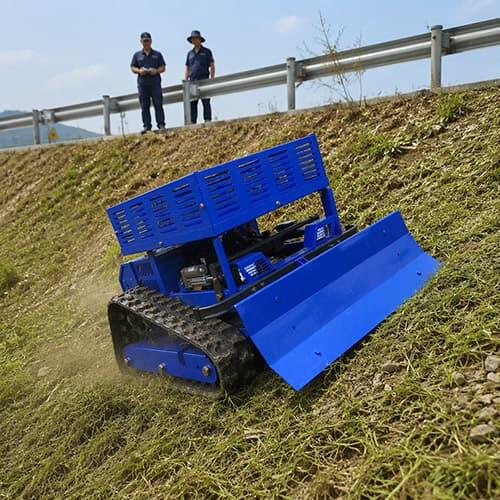
Replacement is the wrong word if it is used as a blanket. A more useful frame is substitution: for a specific task, on a specific site, does an RC machine deliver the same or better result with fewer of the expensive inputs — exposure hours, setup time, callbacks, and operator fatigue?
Three site conditions decide quickly:
Grade and footing. Ground steeper than roughly 15 degrees, or so uneven that a rider would rut it, is where the case for RC strengthens. The exact suitability still depends on the machine's rated operating limits and the conditions on the day.
Debris and throw risk. Roads, fences, playgrounds, and windows nearby raise the value of a controlled, walk-behind-or-remote cut versus a wide-discharge rider.
Access for support. If a truck and trailer can reach the top or bottom of the slope, an RC machine fits the logistics. If not, no amount of clever engineering helps.
Answer those three honestly and most fleets land on the same conclusion: RC replaces a slice of the fleet, not the whole thing. The slice, however, is often the most expensive and dangerous one.
On slopes above 20 to 25 degrees, the traditional answer was a person on a rope or a walk-behind creeping sideways. RC removes the person from the grade entirely. The work is the same; the exposure is not. Contractors report that what used to be a two- or three-hour, high-attention task becomes a steady single-operator pass.
For ditches, batters, and road verges, a compact RC flail or mulcher often matches the width and cut quality of a dedicated slope tractor at a fraction of the purchase price — and it trailers behind a half-ton rather than requiring a lowboy.
What it does not replace is a tractor's three-point hitch work, loader duties, or snow pushing. This is an important distinction when comparing a specialist RC mower with a multi-purpose agricultural machine.
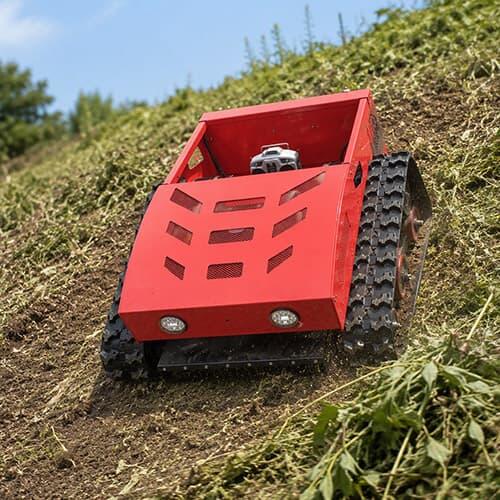
On broken ground, gullies, and wet swales where a rider would tear turf or risk a tip, an RC track machine keeps the operator on solid footing and the machine low and wide. Here the replacement is about protecting the ground as much as the crew.
For these conditions, a tracked mower can make more practical sense than a ride-on machine designed primarily for open, relatively even ground. The benefit is not simply remote operation; it is the combination of machine position, ground contact and operator separation.
Some outfits bolt a slope deck to an existing tractor. RC offers a self-contained alternative: one machine, one engine, one maintenance log. It costs more upfront but removes the compatibility guessing game and lets the tractor stay on level work.
| Traditional role | Where RC can replace it | Where it cannot (yet) |
|---|---|---|
| Rope / harness line-trimming crew | Steep grass faces, ditches, batters | Tight hand-finishing around fixtures |
| Compact slope tractor | Verge and embankment flail work | Loader, three-point, snow duties |
| Ride-on zero-turn | Rough, rutted, or very wet ground | Large open lawns (faster on flat) |
| Bolt-on slope deck | Self-contained slope cutting | Sites needing one tractor for all tasks |
| Manual clean-up crew | Under-brush and light brush mulching | Tree removal, stump grinding |
The honest answer is also the useful one. RC slope mowers are specialists, and specialists have edges.
On a large, smooth sports field or corporate campus, a ride-on zero-turn covers ground faster, cheaper, and with fewer battery or fuel stops. RC gives up speed on the flat.
Once material gets beyond flail-mulch size, a dedicated brush hog, forestry mulcher, or excavator-mounted head is the right tool. An RC mower will struggle, and forcing it shortens deck life.
A tractor that also moves soil, spreads gravel, and clears snow earns its keep through versatility. An RC mower is brilliant at cutting and poor at everything else.
Around signposts, guardrails, and landscape features that need a human eye at hand-distance, a line trimmer or hand crew still wins on finesse.
Rule of thumb: if the site is over about 20 degrees, or the existing method puts a person on the grade, RC deserves a serious look. If the work is flat, fast, and multi-purpose, keep the traditional machine.
The rule is not a substitute for checking the actual machine rating, terrain, vegetation and site conditions. It is a way to decide where a closer equipment comparison is worthwhile.
A straight horsepower or purchase-price comparison misses the point. The real saving shows up in three places that do not appear on a spec sheet:
Exposure hours removed. Every hour a crew member is not on the slope is an hour of liability, fatigue, and incident risk that simply does not exist.
Setup and teardown. No harness rigging, no rope checks, no spotter briefing means more of the day is spent cutting.
Callback prevention. A clean, even cut on the first pass is cheaper than a re-visit after rain or a rutting complaint.
Offset against that are the real costs of adoption: operator training, a spare transmitter battery, a dedicated maintenance window every 50 hours, and the discipline to walk the slope once before each session. None is large. All are non-negotiable.
For a commercial contractor, this is why an RC mower should be evaluated as part of the operating system rather than as a simple machine purchase. Labour, transport, training, maintenance and downtime can change the result of the calculation.
For more examples of remote-control mower operation and different field applications, you can view our RC mower field videos.
Before buying, answer these in writing. If three of four point to RC, it is a fit.
Q: How many slope-hours per week?
More than about ten is the usual crossover point where an RC machine pays for its bay space.
Q: What is the worst grade, and how often?
Steep, repeated faces are the strongest case; one occasional ditch is not.
Q: What does the current method cost in setup?
Long rigging and teardown time is hidden money RC recovers quickly.
Q: Can one trained operator cover the route?
If yes, one machine and one remote can replace a two-person slope crew on many jobs.
These questions also expose situations where an RC mower is not the right investment. If most working hours are spent on flat lawns, tight landscaped areas or tasks requiring a tractor's other implements, replacing the existing machine may add complexity without solving the main productivity problem.
Remote control mowers do not replace a traditional fleet wholesale. They replace the dangerous, slow, setup-heavy slice of it — and that slice is often where contractors lose the most time and carry the most risk. Buy one RC machine for the slopes, keep the ride-ons and tractors for everything else, and the fleet gets stronger rather than more complicated.
If your season includes more than a few steep, wet, or hard-to-reach cuts each week, the question is no longer whether RC can replace traditional equipment. It is which traditional method you will retire first — and how much safer the route will feel without it.
For a specific slope application, cutting width, machine configuration or operating requirement, you can contact our engineering team on WhatsApp for product information.
You can also review our remote control mower product range for different tracked mower configurations.
In some applications, yes. RC mowers are particularly suited to steep slopes, embankments, ditches, rough ground and other areas where putting an operator directly on the grade creates additional exposure. They are not a universal replacement for ride-on mowers or tractors.
Depending on the site and machine configuration, an RC mower can substitute for some rope and line-trimming work, compact slope tractors, ride-on equipment used in difficult terrain and certain dedicated slope-mowing attachments.
Traditional equipment remains valuable for large flat lawns, precision finish work, tight access, multi-purpose agricultural tasks and applications requiring attachments such as loaders, three-point implements or snow equipment.
The purchase price should not be the only comparison. Transport, labour, maintenance, wear parts, operator training and the work that the machine can replace all affect the actual operating cost.
Repeated steep, wet or difficult-to-access mowing is the strongest case. If the existing method regularly puts people on slopes or requires significant setup and teardown, an RC machine deserves a detailed comparison.
No. A tractor remains the better choice when the job also requires soil movement, material spreading, loader work, snow clearing or other agricultural and grounds-maintenance tasks outside mowing.
Get instant pricing, specs, and shipping details from our team.