
86 13686388557

Date:2026-09-30
A working contractor's log of what actually changed on the ground
Everyone talks about autonomy. The sales decks call it the future, the magazines call it a revolution, and the regulator calls it a consultation. None of them are on the slope at six in the morning with a machine that has stopped talking to its map. This is the log of what automation has already changed for the people who actually do the work, and what it has not.
The first change was not a robot. It was the distance between the person and the danger. A radio-controlled machine already removed the operator from the slope; automation is now trying to remove the operator from the radio. That second step is smaller in distance than the first, and far larger in everything else.
The person is still responsible, still paid, and still the one the insurer calls. They just spend more of the day watching a screen and less of it breathing dust.
For a remote control lawn mower, this distinction matters. Remote operation already changes where the operator works, while higher levels of automation add mapping, monitoring and intervention requirements rather than simply removing the human from the process.
A slope cannot be mowed by a machine that does not know where the slope is. So the job now starts with mapping: walking the boundary, marking the obstacles, teaching the machine which grass belongs to the contract and which belongs to the neighbour.
This takes longer than the old first-day drive-around, and contractors who bill it as "just setup" lose money on it. The ones who price it separately are the ones who can afford the machines. Mapping is no longer a favour you do the client; it is a line item.
For automated slope mowing, the map is not just a software feature. It becomes part of the site preparation process, and its quality depends on what was actually observed on the ground before the machine starts working.
An autonomous machine does not need a driver. It needs a watcher, and that watcher is, by every insurance definition that matters, an operator. They carry the transmitter, they stand within line of sight, they take over when the machine meets something its map never learned.
The industry did not remove a job; it split one job into two, and on a wet morning one of them is still standing in the rain.
This is one of the practical differences between an autonomous mower and a conventional RC mower. Remote control does not necessarily mean that the operator is removed from the work. In many applications, the operator remains the person responsible for monitoring the machine and taking control when site conditions change.
Five years ago a tender asked for a qualified operator and a machine with a roll bar. The same tenders now ask for a method statement that names the autonomous system, the geofence, the fail-safe, and the person responsible when the geofence is ignored.
Some clients will not accept a machine that cannot prove where it was. Others will not accept one that needs a person within fifty metres. The contract has become the bottleneck, not the technology.
That change affects equipment selection before a machine ever reaches the slope. A contractor may have a technically capable mower but still need to meet specific site, documentation, supervision or operating requirements written into the contract.
A robot that costs per hour of autonomy rewards a different cutting pattern from a gang that costs per day of labour. The expensive option becomes a lighter cut, more often, because rank growth is what makes autonomous systems stall and ask for help.
On amenity sites this has improved the look. On conservation margins it has quietly changed the sward, and nobody has written that into the contract yet.
The practical lesson is that automation can influence the mowing schedule as well as the equipment. A system designed around frequent lighter passes may behave differently from a conventional commercial mowing operation that allows vegetation to become heavier before cutting.
The machines that used to come in for an oil change and a belt now come in for a software update, a calibration, and a firmware log the dealer wants to read before they will warranty the gearbox.
A contractor who was comfortable diagnosing a sticky clutch now needs someone who can read a telemetry file. The skills did not disappear; they changed clothes.
For an automated slope mower, maintenance can therefore involve both mechanical inspection and digital records. The ability to check conventional wear items remains important, but software versions, calibration and operating data can become part of the service process as automation increases.
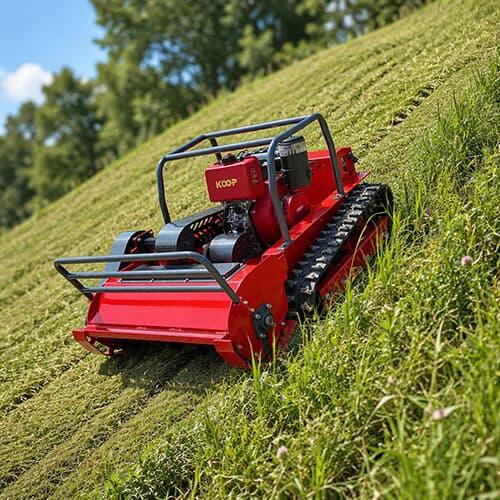
One autonomous machine on one slope is an experiment. Twenty of them, reporting to one tablet in a site office, are a different business.
The economics only start to work when the supervisor stops being a operator and becomes a supervisor again. That is why the uptake has been on solar farms, airfields, and council depots long before it reaches the small contractor.
Automation scales upward; it does not trickle downward by itself.
Fleet operation also changes what buyers need to examine. The question is no longer only whether one tracked mower can complete a slope. It becomes a question of how several machines are monitored, serviced, scheduled and recovered when something interrupts the planned operation.
For examples of remote-control mower operation and different machine configurations, you can view our RC mower field videos.
Legislation in several regions has already decided that an autonomous mower is a robotic workplace device, not a toy, and that the attendant is an operator under safety law.
The practical effect is mundane and important: signage, exclusion zones, recorded handovers, and an audit trail. The slope did not change. The paperwork did, and the paperwork is now part of the slope.
Because regulatory requirements vary by jurisdiction and application, contractors should check the rules that apply to their own site rather than assuming that an autonomous mowing system is treated the same way everywhere.
Autonomy handles the straight, mapped, unchanging face beautifully. It still fails at the things that have always failed: a collapsed culvert, a dog, a bale of wire, grass so long the deck cannot see the ground, a signal that vanishes because a lorry parked in the wrong place.
Every contractor with a year of autonomous work behind them has a story that starts "the map said" and ends with a recovery strap. The machines got better. The world did not.
This is where automation still meets the same physical reality as a conventional commercial mower. Terrain changes, obstacles move, vegetation grows, visibility is lost and communication can be interrupted. A mapped route cannot remove every variable from a working slope.
So the industry changed, but not in the way the brochures promised. It changed in the billing, in the contract, in the skills of the person on the gate, and in the distance between the worker and the edge.
The cutting still happens one pass at a time, and on the days the technology cannot manage that, the person still walks up the bank with the radio. That has not changed at all.
For contractors evaluating automation alongside conventional remote-control equipment, the important comparison is not simply autonomous versus manual. Look at the actual site, the frequency of mowing, operator requirements, mapping work, service capability and the consequences of losing automation during a job.
If you are evaluating a machine for a particular slope application, cutting width or operating configuration, you can contact our engineering team on WhatsApp for product and configuration information.
You can also review our remote control mower product range for different tracked mower configurations.
Not necessarily. Automation can reduce direct manual control, but monitoring, intervention and responsibility can remain with an operator or attendant depending on the machine, site and applicable requirements.
Mapping establishes the working boundary, obstacles and areas that the machine is expected to cover. On a real site, that means walking and checking the terrain before the automated mowing operation begins.
No machine should be assumed to handle every terrain condition. The source specifically identifies changing obstacles, long grass, collapsed drainage structures and interrupted signals as situations that can still require human intervention.
Mechanical maintenance remains necessary, while automated systems can add software updates, calibration, firmware records and telemetry analysis to the service process.
The article's field observation is that managing many machines from a centralized supervision point can create a different operating model from using one autonomous machine on one slope. Fleet scale can therefore change how labour and supervision are organized.
Consider the actual site conditions, mapping requirements, operator and supervision responsibilities, contract requirements, service capabilities, mowing frequency and what happens when the automated system needs human intervention.
Get instant pricing, specs, and shipping details from our team.