
86 13686388557

Date:2026-10-15
Why the banks are harder than the basin, and which machines actually hold them
A retention pond looks like an easy mowing job until you stand at the top of the bank. The water is at the bottom, the grass is thick, the slope can be slick, and the ground under your boots may soften after rain. Drainage swales and culvert outfalls are often more difficult because they are narrow, uneven, and full of material carried in by the last storm.
The mower that handles the soccer field next door is not necessarily the right machine for this work. Around retention ponds and drainage areas, the difficult part is usually not the flat basin. It is the bank, the access, the wet ground and the vegetation growing along the water. That is why the bank should be the starting point when choosing the machine.
The flat floor of a dry detention basin is relatively straightforward. A suitable finishing mower can normally cover open, level ground efficiently. The difficult areas are everything around it: the side slopes, the toe of the bank, the spillway, and the narrow strip between the fence and the water.
Those areas often carry heavier grass, more debris and more difficult ground conditions. They are also where a conventional riding mower stops being a practical solution.
A traditional riding mower puts the operator directly on the machine while it is working beside a slope and water. The higher operator position, tire footprint and rollover risk all become more significant as the bank gets steeper. A rollover toward a pond is not simply an equipment repair problem; it can become a serious emergency.
For that reason, once a pond bank moves beyond a gentle slope, a remote control mower becomes a much more practical platform to consider. The operator can remain on suitable ground at the top or toe of the bank while controlling the machine from a distance. The actual operating limit still needs to follow the machine manufacturer's grade rating and the conditions of the site.
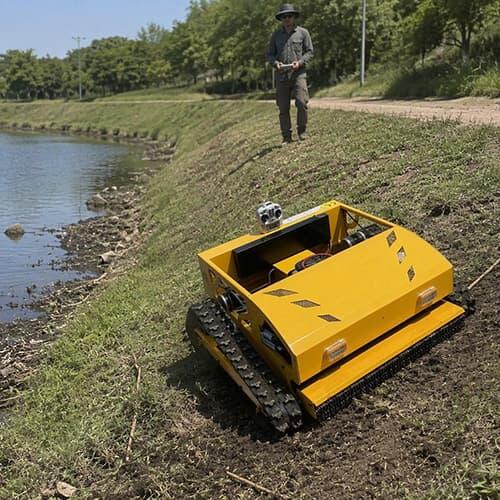
Slopes around stormwater structures are often steeper than they look from a distance. A 3:1 bank is approximately 18.4 degrees, while a 2:1 face is roughly 26.5 degrees. Those numbers can make a substantial difference when deciding between a wheeled platform and a tracked machine.
Do not estimate the slope by eye if the machine selection depends on it. A clinometer or a suitable phone application can give you a useful measurement in a very short time. Once the slope is measured, you can compare the actual site condition with the manufacturer's rated operating range rather than buying from a general description such as “suitable for hills.”
Under about 15 degrees, on ground that drains well, a wheeled remote control mower can often be the economical choice. It can be faster on flatter sections, less expensive to purchase and cheaper to maintain.
Between roughly 15 and 25 degrees, the decision increasingly favors a tracked platform because the larger contact area distributes machine weight over more ground and can help reduce sideways movement. Above 25 degrees, particularly when the grass is wet or the fill is loose, the operating margin becomes much smaller and a suitable tracked machine becomes the more appropriate platform to investigate.
These figures should not be treated as universal limits for every mower. Machine design, center of gravity, track construction, deck position, surface condition and manufacturer testing all affect actual performance. The correct approach is to compare the measured slope and real working conditions with the specific machine's rated capability.
Drainage areas add another variable: the soil itself. Stormwater basins are sometimes constructed from imported material that remains relatively loose for years. It can compact, hold moisture and become slick after rain. A narrow tire can press into soft material and create ruts, while a tracked machine distributes the load over a larger footprint.
For a pond bank that needs to remain intact, the machine should not only be capable of climbing the slope. It should also minimize unnecessary ground damage while doing the work.
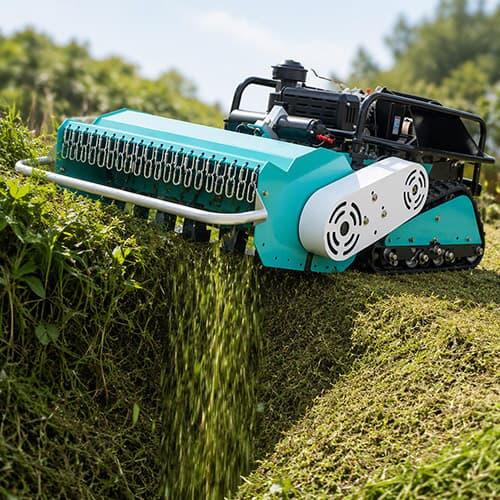
The next decision is the cutting system. A conventional rotary deck can discharge cut material, and on a slope that discharge may travel downhill toward the water. A flail deck uses short hinged knives to cut and process vegetation with much less directional discharge, allowing the processed material to fall closer to where it was cut.
Around stormwater ponds, that difference matters. The goal is not simply to remove grass. You also want to limit unnecessary material being thrown toward the basin and reduce the amount of vegetation and debris that can be carried into the water during the next rain event.
Flail decks are also useful where the basin collects unexpected material. Branches, small pieces of discarded fencing, irrigation components and other debris can appear in areas that look clean during a quick inspection. A flail system with suitable hinged knives can generally tolerate occasional contact better than a conventional finishing deck, although no mower should be treated as a machine for intentionally cutting through hidden metal or large solid objects.
The trade-off is that a flail system is heavier on the drivetrain, can be slower than a finishing mower and normally requires more maintenance. Around water, slopes and debris, those costs can still make sense because the cutting system is better matched to the actual work.
Where the banks are open, short and consistently free of debris, a rotary deck with an appropriate mulching configuration can be a reasonable middle ground. The right choice depends on how the site is actually maintained rather than simply selecting the most aggressive deck available.
Before buying, walk the site and answer four questions. These four checks will usually tell you more about the required mower configuration than a general product brochure.
Retention ponds are often cut during periods such as early summer and late fall, and those mowing windows can follow wet weather. The maximum grade shown in a brochure may be based on a particular test condition, often on relatively firm and dry ground. Actual grass after rain can behave very differently.
For planning purposes, allow a margin below the published maximum rather than treating the maximum number as your everyday working target. If the measured site condition is already close to the machine's rated limit, the next suitable machine class should be considered.
If you can only work from the top, the mower must be able to descend and return under the actual conditions of the bank. If there is reliable access at the toe, working uphill may provide a different operating arrangement.
Access should be measured before the purchase. Check gate width, narrow passages and the turning radius available at both ends of the working area. A machine that cannot reach the bank without major transport equipment is not necessarily the right machine, even if its slope rating looks good on paper.
A basin maintained on a regular schedule usually has shorter and more predictable vegetation. A site left for two months can develop standing material that places a much heavier load on a smaller machine and can cause material to build up around the deck.
Match the engine power and deck to the vegetation you actually allow to develop, rather than the height you hope the grass will remain. This is particularly important when the machine will be used by a contractor across multiple properties with different maintenance schedules.
This question becomes critical when the machine is operating on a slope above water. “The machine keeps going” is not an acceptable answer.
Ask the manufacturer or supplier to explain the actual fail-safe sequence. The machine should have a defined response to loss of remote signal, such as stopping drive and placing the cutting system into its specified safe state. The exact behavior should be confirmed from the machine's operating system and documentation rather than assumed.
If the salesperson cannot clearly explain what happens after signal loss, that is useful information in itself.
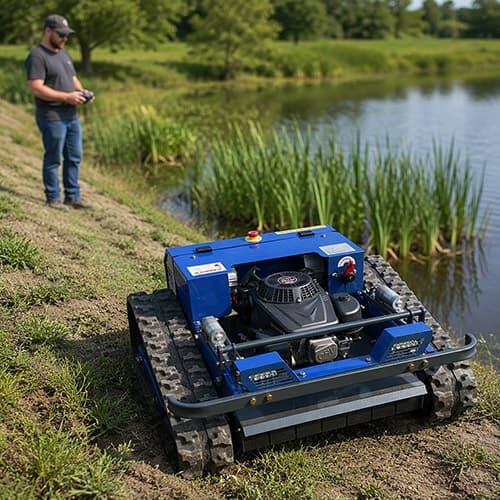
For contractors comparing different remote-control mower configurations, seeing the machine working in real conditions is often more useful than comparing horsepower figures alone. You can also view our remote control mower operation videos on TikTok to see different mowing applications.
For many HOA and municipal retention ponds, a practical starting configuration is a remote control tracked flail mower sized to hold the steepest bank under the expected seasonal conditions, with a deck width that can pass through the available access gate.
A wheeled remote control unit can make more sense for gentler basins and open outfall areas where the ground is firm and the slope is within the machine's rated range. A traditional riding mower can still be useful for fields and flat basin floors where the access and operating conditions are appropriate.
The point is not that one machine style wins everywhere. The banks decide. Measure them, inspect the ground after rain, check the vegetation and access, and select the mower around those conditions. The flat basin is usually the easy part; the bank is where the machine choice earns its value.
For model selection, deck configuration and shipping information, you can contact our team through WhatsApp and provide the slope, mowing area, access width and vegetation conditions.
For steep or wet pond banks, a tracked remote control flail mower is often the most suitable configuration to investigate. The final choice should be based on the measured slope, soil condition, vegetation, access and the machine's rated operating range.
Not in every situation. Wheeled remote control mowers can be economical on gentle, firm and relatively dry ground. Tracks become more useful as slopes become steeper, soil becomes softer or the machine needs to work where maintaining a stable line is more difficult.
A flail deck processes vegetation into smaller material and generally produces less directional discharge than a conventional rotary cutting system. This can be useful around slopes where throwing material downhill toward the water is undesirable. The deck still needs to be selected according to the actual vegetation and debris conditions.
Use a suitable clinometer or phone-based measurement tool rather than estimating the slope visually. Measure the steepest working section and consider the condition when the pond is normally mowed, especially if the ground is commonly wet.
That depends on the machine, soil and slope. Wet grass and soft fill can significantly reduce traction, so the machine should be operated within its rated conditions. A machine that is suitable on dry ground should not automatically be assumed suitable immediately after heavy rain.
Ask the manufacturer to explain exactly what the mower does when the transmitter signal is interrupted. On a pond bank, the machine should have a defined fail-safe response rather than continuing to drive without control. The exact sequence should be confirmed from the machine's documentation.
Get instant pricing, specs, and shipping details from our team.