
86 13686388557

Date:2026-10-02
Nine causes, nine fixes, and how to tell which one is yours
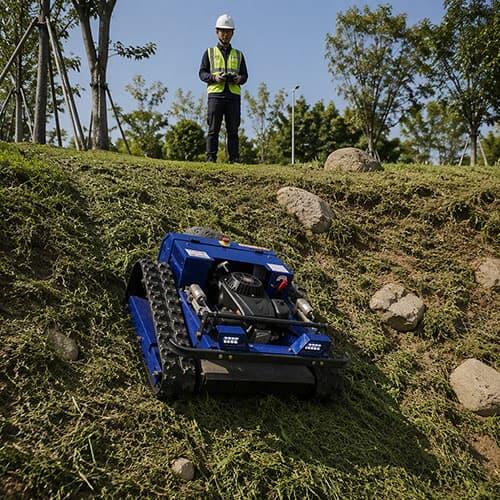
If you have ever felt your remote control mower start to slip on a slope — tracks spinning, wheels churning, the machine just not biting — you are not alone. Traction‑loss issues come up repeatedly in our after‑sales support tickets for slope‑capable RC units. It is almost never because the machine is broken. More often it is a combination of ground conditions, operator setup and normal component wear. Drawing from our field test data and conversations with landscape contractors, here is what is actually happening and how to put it right.
This is the number‑one reason for traction loss, and it is the one nobody wants to hear because the answer is “wait.” When grass blades are slick with dew or rain, the contact patch between your track or tyre and the ground drops sharply. A tracked unit that climbs a twenty‑five‑degree dry slope without breaking a sweat will slide sideways on the same face if the grass is wet. During our slope testing, we have measured effective grip dropping 5‑10 degrees purely from morning dew, with zero change to machine hardware.
The fix is not mechanical — it is timing. Wait for the sun to dry the face, or if the job cannot wait, keep your path strictly horizontal across the slope. Never go straight up and down when it is slick.
This sounds obvious, but it happens constantly out in the field. A machine rated at thirty degrees does not mean it handles thirty degrees in mud, on loose soil or with worn tracks. If the hill you are on exceeds the sustained‑angle rating — especially once you factor in wet grass, which can knock five to ten degrees off your effective grip — weight transfer pushes the entire load onto the downhill side. The uphill track or wheel lifts. No contact, no drive.
Measure the slope with a clinometer before you blame the machine. If it reads higher than the spec sheet, you have found your problem. Many operators rely on visual guesswork; phone inclinometer apps remove that guesswork entirely.
On tracked machines, the moulded lugs on a rubber track are what bite into the ground. When those lugs wear flat — usually after two to five hundred hours depending on terrain — you are essentially driving a smooth belt on dirt. It will not hold on anything over fifteen degrees. The same logic applies to wheeled units: if the tread is bald or the tyres are packed with mud, you have lost your grip before you even start.
Run your hand across the lug. If you cannot feel a defined edge, it is time to replace. And replace in pairs. A new track on one side and a worn one on the other will pull the machine sideways and chew through the new one faster. We regularly see premature new‑track failure on customer fleets that skip this simple rule.
This one fools even experienced operators. You hang a trimmer rack on the front, load the rear carrier with fuel cans and water jugs, and the driven axle loses bite because the load has moved away from it. On a slope, that shifted weight decides which axle is doing the work. If the driven wheels or tracks lose weight, they lose grip.
Keep heavy items low and centred between the axles. Batteries, fuel and water belong between the axles, not hanging off the back or stacked on the front rack. One municipal customer told us their traction issues vanished just by repositioning full fuel cans away from the rear mounting points.
On wheeled machines, too much pressure shrinks the contact patch to a thin ribbon. Too little and the sidewall flexes so much that the machine wanders, with the added risk of cutting the tyre on the rim. Plenty of contractors run twenty‑eight PSI on tyres that should sit at eighteen, simply because it rides better on the trailer. On a slope that over‑inflation destroys traction.
Check the door placard or the manual, set it cold, and recheck after a few hours of work. Heat from field operation will raise internal tyre pressure and alter real‑world ground contact.
When your cutting deck hits tall, thick material — waist‑high ragweed, wet brush, dense fescue — the blades bog down. On shared‑pump hydrostatic systems the circuit steals flow from the traction side to keep the blades turning. The machine slows, the tracks spin, and you assume it is a traction problem. It is a deck problem.
Clear the material, raise the deck and make a second pass. If the machine climbs cleanly with the blades off, you have found it. Many new operators overlook this condition and mistakenly pursue costly undercarriage repairs.
Mud, grass and leaves all pack between the track and the roller. That debris changes the effective diameter of the roller, tightens the track beyond specification and reduces ground contact. The machine rides on a lump instead of on the full belt. Flip the machine or pressure‑wash the undercarriage after every wet job. Skip this and you shorten track life while killing traction at the same time.
On tracked machines, if one drive motor is bleeding pressure internally — usually through wear or contamination — one track crawls while the other spins at full speed. The machine pulls hard to one side and will not hold a grade. On wheeled units with a limited‑slip differential, a diff that will not engage leaves one wheel spinning while the other does nothing.
Pressure test the motors and do not keep climbing slopes until this is fixed. A sudden single‑side failure on a hill is how machines roll. This fault should only be diagnosed in‑shop; never troubleshoot drive motors while operating on an active slope.
You start on packed clay and all is well. Then you cross a patch of loose gravel or leaf litter. Loose material sitting on a hard base behaves like ball bearings. Tracks float and wheels spin. Slow down and read the ground. If you see loose material on a slope, pick a different line or stabilise it first.
Traction is not a single part you can swap out. It is the sum of ground condition, machine setup, operator habit and wear parts. Start with the simplest things: clean the undercarriage, check the tracks, wait for dry grass. Most traction‑loss support calls are solved in those first three steps. If you would like to view real‑world slope‑slippage test footage, we have shared examples on our TikTok channel.
The machine is probably fine — the setup just is not right yet. You can browse various tracked and wheeled slope‑mower models on our Made‑in‑China store page.
If you are dealing with persistent slipping issues on your worksite, talk through your slope conditions with our engineering team via WhatsApp.
Get instant pricing, specs, and shipping details from our team.