
86 13686388557

Date:2026-06-12
One of the main reasons why contractors, municipal authorities, orchard owners and property maintenance companies invest in purchasing Remote Control Lawn Mower is that they can safely handle steep slopes that traditional equipment cannot handle. Whether it's maintaining roadside embankments, solar power plants, mountain trails, orchard terraces or commercial green belts, the ability to perform slope operations is usually the most important factor in the purchase decision.
However, one of the most misunderstood questions in the industry remains:
"What is the actual maximum slope an RC lawn mower can safely handle?"
Many manufacturers advertise climbing abilities of 45°, 50°, or even higher. While these numbers may be technically achievable under controlled testing environments, real-world conditions are very different. Wet grass, loose soil, thick weeds, uneven terrain, and changing weather conditions all affect actual working performance.
As commercial demand for Remote Control Crawler Lawn Mowers continues to grow in Europe and North America, understanding the differences between laboratory ratings and actual operational capabilities has become increasingly important for buyers seeking to maximize equipment safety and return on investment.
The first thing every buyer should understand is that a manufacturer's advertised maximum slope is typically measured under ideal testing conditions.
These tests are usually performed on:
Dry ground
Short grass
Perfect traction conditions
No heavy vegetation load
Consistent terrain surface
Actual field conditions are rarely ideal.
Professional landscaping contractors frequently encounter:
Wet slopes after rain
Loose gravel surfaces
Dense overgrown weeds
Uneven terrain
Mud and soft soil
Hidden obstacles and rocks
Because of these factors, the practical working angle of a mower is often 20%–40% lower than its advertised laboratory rating.
This is why experienced contractors focus on continuous safe operating angles rather than marketing specifications.
Most residential models are designed for homeowners maintaining moderate backyard slopes and private properties.
Typical specifications include:
Advertised slope: 30°
Practical working slope: 25°–28°
Light-duty track systems
Higher center of gravity
Basic traction design
These machines are suitable for routine residential mowing but are not intended for demanding commercial slope work.
This category has become one of the most popular choices among orchard owners, estate managers, and small landscaping contractors.
Typical capabilities include:
Advertised slope: 40°
Practical working slope: 35°–38°
Reinforced anti-slip tracks
Improved weight distribution
Enhanced climbing performance
For most commercial applications, a quality Crawler Lawn Mower in this category can comfortably handle over 90% of real-world slope maintenance tasks.
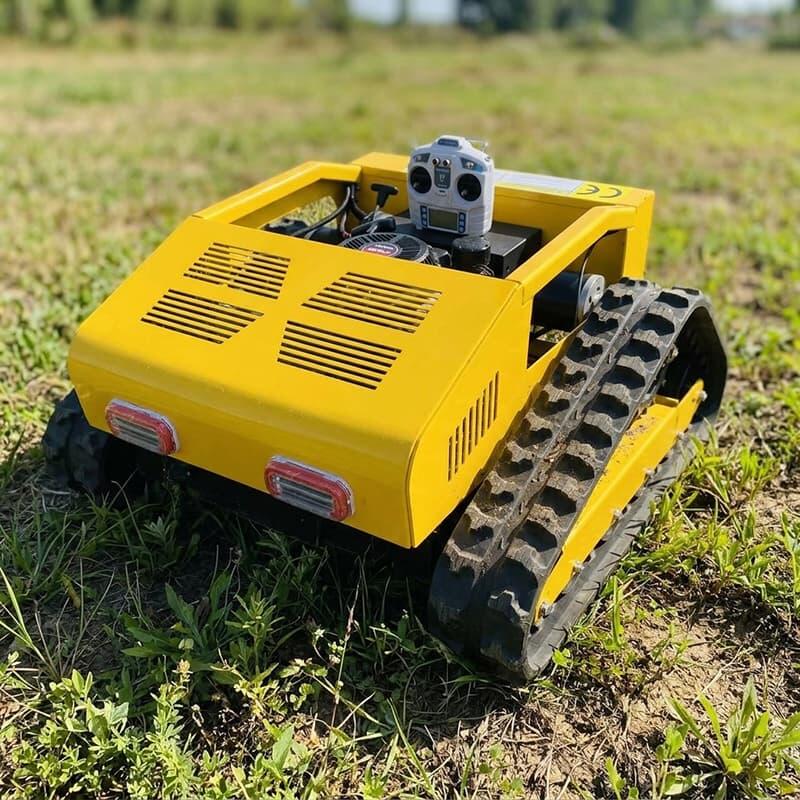
Industrial-grade machines represent the highest level of current slope mowing technology.
These units are commonly used for:
Highway embankments
Solar farm maintenance
Mountain vegetation management
Municipal slope projects
Large-scale infrastructure maintenance
Typical performance:
Advertised slope: 45°–50°
Practical working slope: 40°–45°
Low center-of-gravity chassis
Industrial-grade crawler tracks
Adaptive torque control systems
Many contractors first evaluate real hillside performance through demonstration videos available on our official TikTok channel, where actual field tests showcase operation on steep commercial slopes rather than laboratory environments.
Several critical factors influence real operating performance.
Wet grass dramatically reduces traction. A mower capable of working safely on a dry 40° slope may only handle 30°–35° after rainfall.
Perfectly smooth hillsides rarely exist. Small bumps, depressions, rocks, and uneven surfaces can significantly affect machine balance.
Dense weeds and brush increase cutting resistance, forcing the mower to work harder while climbing.
Vertical travel is always more stable than side-slope mowing. Lateral movement can reduce safe operating angles by 5°–8°.
Based on feedback from contractors worldwide, four factors consistently determine whether a mower can safely perform on steep terrain.
Low Center of Gravity Design
Wide Reinforced Crawler Tracks
Adaptive Torque Management
Automatic Safety Protection Systems
Professional buyers should pay more attention to these engineering features than simply comparing horsepower numbers.
Many international distributors sourcing equipment through our Made-in-China storefrontoften request real slope-testing reports before purchasing, because actual terrain adaptability is far more important than advertised specifications.
| Working Condition | Recommended Usage |
|---|---|
| Dry, Short Grass | 100% of Rated Slope |
| Normal Mixed Terrain | 85% of Rated Slope |
| Wet or Muddy Ground | 70%-75% of Rated Slope |
| Lateral Side-Slope Operation | Reduce Angle by 5°-8° |
Only under ideal conditions. For long-term commercial work, maintaining a safety margin is strongly recommended.
Poor chassis balance, low-quality tracks, and inadequate traction systems often cause instability despite impressive marketing claims.
Both can perform exceptionally well when properly designed. Modern industrial electric mowers often provide smoother torque delivery, while diesel units excel in continuous heavy-load applications.
Most professional contractors consider 35°–40° the ideal range for balancing productivity, safety, and equipment longevity.
Request on-site footage, project case studies, and technical documentation. Buyers requiring actual slope testing videos, machine recommendations, or project-specific advice can also contact Cara via WhatsApp (+86 15244567951) for practical application guidance.
The maximum slope a Remote Control Lawn Mower can handle depends on far more than the number printed in a brochure. While residential machines may safely manage 25°–28°, professional-grade commercial crawler mowers can achieve stable operation on slopes reaching 40°–45° under appropriate conditions.
The smartest purchasing decision is not choosing the mower with the highest advertised angle, but selecting equipment whose real-world performance matches your terrain conditions. Whether maintaining orchards, solar farms, highway embankments, or commercial landscapes, investing in a properly engineered Commercial RC Mower delivers safer operation, higher productivity, and stronger long-term returns.
For additional product specifications, dealer cooperation opportunities, and commercial procurement support, many overseas buyers also explore ourAlibaba showroomto compare configurations and project solutions.
Get instant pricing, specs, and shipping details from our team.