
86 13686388557

Date:2026-06-10
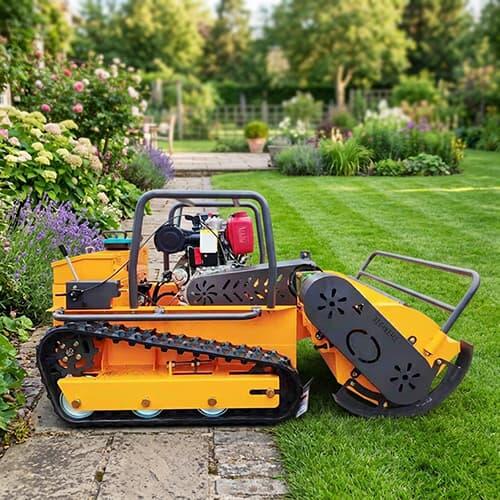
For professional landscaping contractors, municipal maintenance departments, vegetation management companies, and large-scale land clearing teams, choosing the right remote control crawler lawn mower is no longer just about mowing the grass. Heavy-duty operation projects often involve dense shrubbery, steep slopes, roadside embankments, abandoned land restoration, solar power plant maintenance, and long-term operations. In these cases, the reliability of the equipment directly affects the profitability.
In recent years, the market has been dominated by two major categories: diesel-powered RC lawn mowers and modern industrial electric RC lawn mowers. Both offer significant advantages, but they serve different operational requirements.
Many overseas buyers frequently consult our team through channels such as Alibaba stores and production platforms, asking whether diesel engines are still the best choice for demanding applications. The answer is far more complex than many people expect.
This comprehensive comparative study examines power output, runtime, terrain performance, maintenance requirements, operational costs, regulatory compliance, and long-term return on investment to assist commercial buyers in selecting the most suitable solution.
Many buyers focus exclusively on horsepower numbers. However, true heavy-duty mowing performance depends on a combination of sustained torque output, operational stability, downtime reduction, and adaptability to complex environments.
Traditional diesel machines remain extremely powerful in harsh vegetation-clearing applications, while modern industrial electric mowers are rapidly gaining market share due to lower operating costs, reduced maintenance, and increasing environmental regulations throughout Europe and North America.
When dealing with thick brush, overgrown weeds, roadside vegetation, and abandoned land restoration, power becomes the most critical factor.
Diesel RC lawn mowers generate exceptional low-speed torque. Their engines maintain consistent output under heavy resistance and can easily process dense vegetation, woody stems, and unmanaged growth without significant power loss.
For contractors involved in large-scale land reclamation or vegetation reduction projects, diesel machines often provide superior brute-force cutting capability.
Electric RC lawn mowers, however, offer instant torque delivery through industrial brushless motor systems. Modern high-voltage electric platforms can achieve cutting performance surprisingly close to diesel units for most commercial mowing tasks.
For routine commercial slope maintenance, municipal mowing, solar farm vegetation control, and landscaping projects, industrial electric units typically provide more than sufficient power while delivering smoother operation and reduced vibration.
Heavy-duty contractors frequently operate equipment for 8 to 12 hours per day.
Diesel-powered machines hold a clear advantage in runtime flexibility. A full fuel tank can often support 6–8 hours of intensive operation, and refueling requires only a few minutes.
This makes diesel equipment particularly suitable for:
Highway slope maintenance
Remote mountain projects
Large agricultural land clearing
Infrastructure vegetation management
Electric mowers rely on battery capacity. Premium commercial units now achieve 4–9 hours of operation depending on battery specifications and workload.
With modern quick-swap battery systems, downtime remains minimal, although additional battery packs are required for all-day operation.
Both diesel and electric commercial models utilize crawler track systems and low-center-of-gravity chassis designs.
Diesel machines generally weigh more, creating additional traction and stability on extremely steep slopes exceeding 38 degrees.
Their increased mass can improve performance on rugged, undeveloped terrain where traction is critical.
Modern electric crawler mowers compensate through intelligent torque management systems that automatically adjust output according to resistance levels.
This technology provides excellent stability while minimizing turf damage on softer ground.
Many professional users who follow our product demonstrations through TikTok channels have reported excellent results on embankments, solar farms, orchards, and commercial greenbelt maintenance projects.
For buyers interested in seeing actual field operation footage, many working examples can be viewed through our official media channels and manufacturing showcase platforms.
Long-term operating cost is often more important than initial purchase price.
Diesel machines require:
Engine oil replacement
Fuel filter maintenance
Air filter servicing
Fuel system inspections
Regular engine maintenance
Fuel expenses also accumulate significantly during high-volume commercial operations.
Electric models eliminate most of these costs.
There is no fuel system, no oil changes, and fewer mechanical wear components. Routine maintenance primarily involves:
Blade inspection
Track maintenance
Battery management
For many landscaping companies, electric equipment can reduce annual operating costs by as much as 60–70%.
Environmental regulations are reshaping the global lawn care industry.
Throughout Europe and many North American cities, low-emission and low-noise operation is becoming mandatory.
Diesel equipment continues to perform well in:
Remote industrial zones
Agricultural land management
Mountain vegetation clearing
Infrastructure projects
However, restrictions are increasing within:
Urban parks
Residential communities
Schools
Public recreation areas
Electric RC lawn mowers offer zero emissions and significantly lower operating noise, making them ideal for environmentally sensitive projects.
Diesel engines have a proven history of durability when properly maintained. Many commercial units remain operational for 6–8 years under demanding conditions.
Modern electric systems feature sealed brushless motors and IP-rated electronic protection systems. With fewer moving components, they often experience fewer mechanical failures and more predictable maintenance schedules.
| Evaluation Item | Diesel RC Lawn Mower | Industrial Electric RC Lawn Mower |
|---|---|---|
| Cutting Power | Excellent | Very Good |
| Runtime | Unlimited with refueling | Depends on battery capacity |
| Slope Performance | Excellent | Excellent |
| Maintenance Cost | Higher | Lower |
| Noise Level | Higher | Very Low |
| Emission Compliance | Limited | Excellent |
| Long-Term ROI | Good | Excellent |
For approximately 90% of commercial mowing projects, modern industrial electric models can successfully replace diesel equipment. Diesel remains advantageous for extreme brush-clearing and continuous remote operations.
Electric models generally provide higher long-term profitability due to lower fuel and maintenance expenses, while diesel machines excel in specialized heavy-clearing environments.
Yes. Premium crawler models feature intelligent torque control systems that maintain stable power delivery on demanding slopes.
Local environmental regulations, project types, operating hours, and maintenance infrastructure should be evaluated before selecting diesel or electric equipment.
Professional buyers often contact factory specialists before purchase to match machine specifications with local terrain conditions and project requirements. Our export team, including Cara, regularly assists distributors and contractors worldwide with equipment selection and technical consultation through WhatsApp support and online communication channels.
There is no universal winner between diesel RC lawn mowers and industrial electric RC lawn mowers. The ideal choice depends entirely on your operating environment, workload intensity, local regulations, and long-term business strategy.
For extreme vegetation removal and continuous remote operations, diesel remains the preferred solution, while electric equipment represents the future of efficient, low-maintenance, and environmentally compliant commercial lawn mowing.
For contractors and distributors focused on sustainable growth, selecting the right power platform today can significantly enhance operational efficiency, reduce ownership costs, and improve long-term profitability.
Get instant pricing, specs, and shipping details from our team.