
86 13686388557

Date:2026-10-19
A working owner's honest rundown of what actually changed — the wins, the trade-offs, and the things nobody warned us about.
We didn't switch because we were excited about new equipment. We switched because the old way had stopped working. Two walk-behind machines, a crew of three, and a handful of banks and retention ponds we'd quietly stopped bidding on because the liability and the time never added up.
The tracked remote control mower showed up on a Tuesday. By Friday we already knew we weren't going back. But it wasn't the clean win the brochure promised, either.
Here's what actually changed after a full season on tracks.
This is the big one, and it's the reason most people buy the machine in the first place.
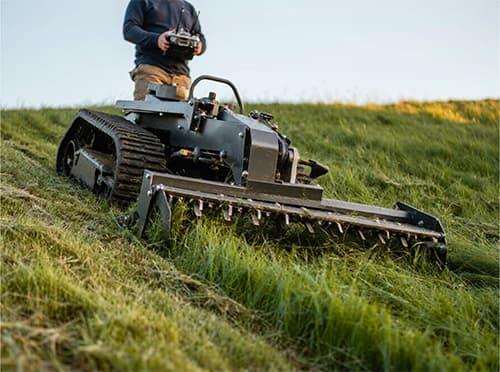
On wheels, a sidehill is a constant negotiation: you feel the machine wanting to drift, you ease off throttle, you pick a slightly different line, you hold your breath for the last ten feet. On tracks, that negotiation becomes much easier to manage. The machine settles into the grade instead of constantly fighting for position.
You stop thinking only about whether the machine will hold its line and start thinking about the next pass. That difference becomes noticeable when the crew is working a bank repeatedly rather than demonstrating the machine for a few minutes.
The psychological shift matters more than the spec sheet. Our crew stopped treating steep ground as a special operation that needed a briefing and a second person watching. It became ordinary work. That alone changed which jobs we'd quote and which we'd politely pass on.
We expected better traction. We didn't expect to keep working through weather that used to shut us down entirely.
Rubber tracks don't make a machine immune to soft ground, but their larger contact area spreads the load differently. In our work, that meant the tracked mower was less likely to sink deeply into soft ground than the wheeled unit it replaced. After a rainy night we could sometimes be on a bank the next morning while the flat fields were still too wet to touch.
The catch: wet grass still clumps, and a tracked machine is no substitute for a sharp blade and a reasonable deck height. The tracks changed how the machine dealt with the ground; they did not change the cutting characteristics of wet vegetation.
We learned to take a higher first pass and come back lower — a habit we never had the time for before. That approach also gave us more control when the vegetation was heavy or the surface underneath was still soft.
The real gain wasn't cutting faster. It was cutting on days we used to write off. Over a season, those recovered days are worth more than the speed increase.
That's what we tell people now when they ask if it was worth it.
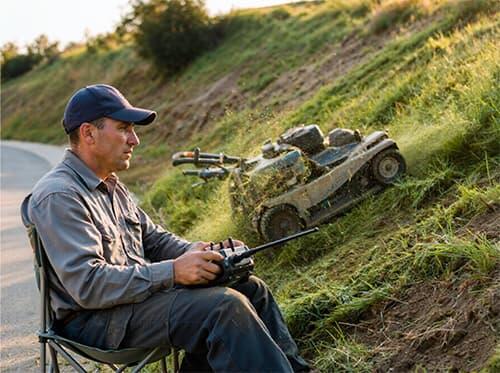
This surprised us. A remote control lets you put your eyes somewhere useful. Instead of sitting behind the cut, you're standing thirty feet up the slope watching the edge of the deck and the line it's leaving.
You see a missed strip instantly. You see where the grade changes and the machine needs to slow down. Our striping got noticeably cleaner in a way no one predicted when we first compared the machines.
It also meant we stopped damaging edges. On a riding machine you're always a little farther from the rim than you'd like. With the remote, the operator is the one choosing the viewpoint, and that changes the result more than any deck upgrade.
That operator position is particularly useful around drainage edges, pond banks and irregular transitions where seeing the deck from a different angle can be more useful than simply increasing cutting width.
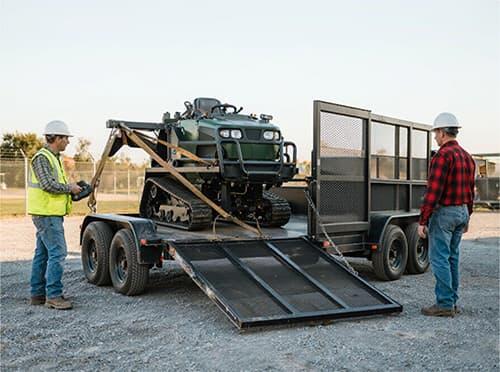
Here's the part the demo video doesn't show: getting the thing on and off the trailer.
A tracked unit is heavier than the wheeled machine it replaces, and it doesn't push easily by hand. We added a winch and a set of ramps rated for the weight, and we built a loading routine we now follow every single time. Skip a step and you've got a problem.
The first month we lost more time loading than we saved cutting. That ratio flipped, but it took discipline — and a trailer setup we'd never needed before.
Budget for this. Transport equipment is part of the tracked mower setup, not something to figure out after the machine arrives.
For contractors moving between several properties in one day, the loading routine can affect productivity almost as much as cutting speed. Ramps, winch capacity, trailer deck height and machine weight should be considered together before purchase.
With a wheeled mower you check the air and forget about it. Tracks demand attention.
Stones wedge in. Guides wear. Tension drifts, and a track that's too tight can put unnecessary load on bearings while a track that's too loose can come off. We ended every day with a five-minute look: pick out debris, check for cuts, and eyeball the sag.
Were the tracks a headache? Sometimes. Were they worth it? Absolutely — but only because we treated them as a wear item from day one instead of waiting for a failure.
Replacement cost stings less when you've planned for it. The same applies to sprockets, idlers and other undercarriage components. A tracked RC mower should be maintained as a working machine, not treated like a sealed appliance.
Every morning: walk the tracks, pull embedded rock and debris, and check tension against the mark.
Every 50 hours: inspect sprockets, idlers and the inside edges where mud packs in.
At the first sign of a cut or a missing lug: rotate or replace — don't wait for the week to end.
After wet, gritty work: rinse the undercarriage. Packed clay is what actually shortens track life.
These are simple checks, but they are exactly the kind of routine that separates planned maintenance from an unexpected job stoppage.
We thought the mower was the investment. Half a season in, it's clear the transmitter is the linchpin.
Battery discipline, line-of-sight habits, a spare transmitter for the jobs that run long — these are the things that keep you working. We charge two batteries every night, keep the spare in the truck, and never start a big bank without it.
We also learned to test the fail-safe on every new site before the first cut. You need to know, in that ground, what the machine does when the signal disappears. The exact response depends on the mower's control system, so this is something worth verifying on the actual machine rather than assuming from a brochure.
Hope is not a plan. A remote-control mower should be tested in the working environment, with the operator familiar with the transmitter, signal behavior and fail-safe response before production mowing begins.
For crews using a tracked RC mower commercially, the transmitter is therefore part of the equipment package. Spare batteries, charging routines and basic transmitter checks deserve the same attention as blades and tracks.
The machine isn't dramatically quicker on flat ground. Where it wins is everywhere else: no ride to the top, no slow crawl across soft verges, no second pass with a string trimmer along the rim.
The gains are in the margins, and they add up to roughly a third of a day per crew per week for us.
That number is our operating experience, not a universal productivity figure. Terrain, vegetation, cutting width, transport distance, operator experience and maintenance all change the result. But the pattern stayed consistent for our crew: the tracked mower saved time mainly by reducing the small delays around difficult ground.
The flip side is prep time. Fuel, charging, a walk of the slope, checking the transmitter, unloading — it all has to happen before the first cut.
A tracked RC mower rewards a crew that runs a routine. It punishes one that shows up loose.
The first time we showed up with it, a property manager watched for twenty minutes from her car. The next day we had two referrals.
People respond to a machine that can work in areas where putting an operator directly on the slope is difficult. To a customer, the equipment communicates something about how the contractor approaches difficult ground.
We've used it as a talking point exactly twice, and both times it led to a maintenance contract we wouldn't have been offered otherwise.
That's not why we bought it. But it's the easiest part of the whole story to explain.
For contractors, the value of an RC mower therefore isn't limited to cutting performance. Being able to explain the equipment, show how the operator works from a controlled position, and demonstrate the machine on difficult terrain can also become part of the sales conversation.
Yes. Would we do it the same way? No — we'd sort the trailer and the transmitter routine first, and we'd plan for tracks as a wear item from day one instead of month six.
The honest summary: switching to a tracked remote control mower didn't make every part of the job easier. It made the hard part easier, and it moved the difficulty into places we could plan for — loading, maintenance, and how we run a site.
For us, that's a much better trade.
If you're comparing a tracked RC mower with a wheeled remote control lawn mower, don't judge the machine only by its cutting speed or maximum slope number. Look at the complete working routine: how it gets to the site, how the tracks are maintained, how the transmitter behaves when the signal changes, what parts are available, and how the machine fits the terrain you actually mow.
For more real operating footage and different terrain applications, you can also see our remote control mower videos.
If you are evaluating a tracked mower for commercial ground maintenance, slope mowing, retention ponds or similar work, you can contact our team through WhatsApp to discuss the terrain, cutting width and configuration you are considering.
No. Our experience was based on steep banks, retention ponds and wet ground. On flat, open ground, a wheeled mower can still make sense because it may be lighter, easier to transport and simpler to maintain. The advantage of tracks becomes more meaningful as terrain and ground conditions become more difficult.
Not necessarily. In our case, the main productivity gain came from being able to keep working difficult areas and from reducing small delays around slopes, soft verges and pond edges. Flat-ground cutting speed was not dramatically different.
Daily checks should include debris, visible damage and track tension. Periodic inspections should include sprockets, idlers and areas where mud or clay can pack into the undercarriage. Wet and gritty work deserves additional cleaning because abrasive material can accelerate wear.
Tracks can provide more useful ground contact on soft terrain, but they do not eliminate the problems caused by wet vegetation. Wet grass can still clump and place additional demand on the cutting system. In our work, taking a higher first pass before lowering the deck worked better than trying to cut everything at once.
Look beyond the machine itself. Check the total machine weight, transport method, ramp and winch requirements, track maintenance procedure, spare parts availability, transmitter battery arrangements, fail-safe behavior and the mower's rated operating conditions. A demonstration on the type of terrain you actually maintain is more useful than a short demonstration on flat ground.
It can be, particularly where difficult slopes, wet verges, pond banks or other terrain make conventional equipment inefficient for the job. The right configuration still depends on vegetation, terrain, cutting width, transport arrangements and the manufacturer's operating limits.
Get instant pricing, specs, and shipping details from our team.