
86 13686388557

Date:2026-10-23
It is not the horsepower, the price, or the brand
Most shoppers select a remote‑control mower by only reviewing key figures printed on the spec sheet: maximum grade rating, horsepower, deck width and price. They compare these listed specifications, pick what appears to be the best‑value unit, and wait for delivery several weeks later. Too many buyers then discover those brochure numbers do not match real‑world job‑site performance. Drawing on our pre‑sales consultation and after‑support ticket data, the single largest purchasing mistake is selecting equipment before you measure the actual ground where the machine will operate.
Every manufacturer publishes a maximum slope‑grade rating. In most cases that rating is accurate — but only under controlled factory test‑lab conditions: clean, dry, compacted ground and ideal test‑day operating parameters. That scenario rarely matches your real‑world worksite in early spring. Your slopes may be wet, scattered with loose rock, covered in over‑grown long grass, and feature rutted turnaround zones that you may overlook during planning. A unit rated for 45‑degree slopes can struggle to hold stability on a 35‑degree slope after rainfall. The specification number itself is factual; yet the test‑site conditions do not reflect your property.
Before contacting any dealer, complete on‑site measurements. An affordable clinometer or smartphone inclinometer app delivers readings accurate to within one degree. Walk your whole site and record angles for the slope faces you will mow every two weeks — not just the steepest single patch across the whole acreage. Then reduce that measured figure to account for wet‑soil performance. This adjusted value is the real‑world requirement your machine must satisfy. If you shop purely against dry‑test‑spec numbers, you are purchasing for a test track instead of your actual job‑site terrain.
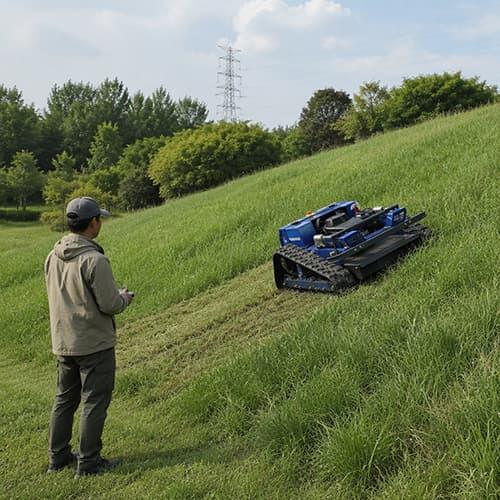
Two separate RC mower models can carry identical published grade ratings but deliver completely different real‑world slope behaviour. The critical differentiator is ground pressure, the PSI load the equipment transfers through its contact patch to the soil. Wheeled mowers concentrate total weight onto narrow tyre ribs. Tracked units spread weight across the full length of track. Lower ground‑pressure prevents sinking, rut formation, and unexpected slip‑offs on soft embankments. This metric largely determines whether your machine maintains stable footing once the ground surface turns soft underneath it.
Most buyers never ask suppliers for ground‑pressure figures. This data seldom appears on front‑page marketing brochures. Nevertheless, for ditch lines, pond banks, reclamation land, or freshly graded ground, ground‑pressure decides between smooth continuous mowing or having to winch a stuck machine out of the mud. Request ground‑pressure data from your dealer, or ask for track footprint dimensions so you can calculate the value yourself. If a supplier cannot provide these figures, it tells you a great deal about how the machine was engineered.
Wet grass changes everything. This mistake becomes costly under damp conditions. If you select a machine that only just meets your dry‑slope rating, you will quickly find the same slope effectively becomes 5‑8 degrees harder to negotiate after rain. The machine creeps sideways, operators lose confidence, and the core benefit of RC mowing — keeping personnel safely off steep slopes — gets discarded. Crews revert back to manual string‑trimmer work along slope edges.
The simple yet widely‑ignored solution: spec your machine for wet‑day slope performance instead of dry‑day conditions and preserve adequate safety margin. If your real‑world measured slope is 25 degrees, avoid buying a machine rated exactly for 25‑degrees. Select a unit rated for 35‑40‑degrees, so you still stay safely within operating limits when soil softens. Larger safety margin increases upfront cost, yet pays dividends the very first time you can complete work on a Tuesday rather than waiting until Friday for ground to dry out.
A tracked RC mower is not light weekend‑use equipment you simply roll out of a garden shed. It is heavy‑duty industrial machinery that requires loading, unloading, and secure tie‑down procedures every single time you deploy it. Many buyers focus entirely on cutting‑performance and overlook trailer logistics. Machine overall width, operating weight, loading‑ramp angle, and factory tie‑down anchor points all must match your existing setup. A machine with excellent slope‑mowing capability that cannot fit through your access gate or demands a trailer you do not own is not the correct equipment for you.
Measure gate openings, trailer deck dimensions, and check ramp angle against the unit’s minimum ground clearance. Also factor in practical human considerations: who will lift heavy ramps, and how frequently this will happen each week. These are not flashy marketing points, yet they determine whether your machine sees regular use or sits unused inside storage yards.
What happens when the remote‑control signal drops out? Hardly any purchasers raise this question, yet it represents one of the most critical safety considerations. Operating on slopes, a machine that keeps driving without valid operator input is not just a minor fault — it becomes a runaway hazard. A properly‑designed RC system must disengage blade clutch, throttle down to idle speed, and hold position in a predictable, defined manner. Two‑second maximum response time is a reliable benchmark you should hold dealers to.
Always request an on‑site live demonstration. Ask sales staff to drive the machine onto an actual slope, then deliberately power off the remote transmitter. Observe exactly how the equipment reacts. An answer like “the emergency stop button is on the remote” is insufficient; remote‑handset batteries can fail mid‑operation. If the demonstration outcome makes you feel uneasy, trust that instinct. Six months later you will be the operator standing at a distance holding that transmitter.
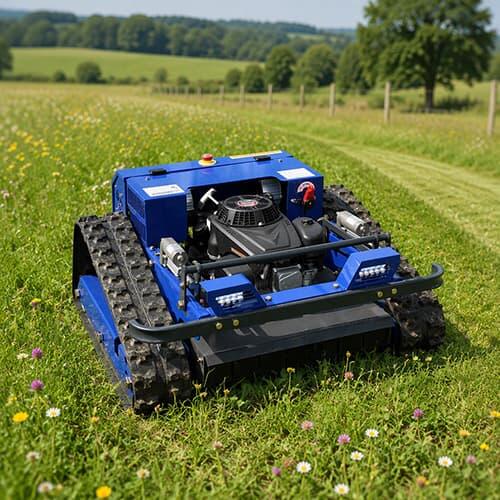
Complete these four assessment steps in sequence before browsing equipment catalogues:
Record real‑world slope‑grade values under both wet‑soil and dry‑soil conditions for the slopes you intend to mow.
Document your worst‑case surface conditions: soft mud, rock‑strewn ground, ruts, or heavy over‑grown vegetation.
Measure every gate, trail opening, and trailer access dimension between your storage location and job‑site.
Note travel distance from vehicle parking point to first cutting zone, plus how frequently you make that transit run.
Document these four sets of findings before you look at any machine specifications. Most catalogue options will immediately drop out of consideration. Your purchasing decision becomes straightforward. You stop shopping for “the best machine on paper”, and start shopping for “the right machine for your site”.
The biggest purchasing error is treating RC‑mower shopping as a pure spec‑comparison exercise, while treating real‑world ground conditions as an afterthought. The reality works the opposite way: your slope terrain dictates which machine you need. Measure your actual site slopes, apply a safety adjustment factor for wet‑soil scenarios, and purchase with adequate performance margin. Everything else including horsepower, brand name, and paint colour are secondary details.
You can view real‑world slope test demonstration footage on our TikTok channel. Review our range of tracked RC slope‑mower models on our Made‑in‑China store page.
If you need support evaluating your site parameters before you place an order, share your terrain details with our engineering team via WhatsApp.
Get instant pricing, specs, and shipping details from our team.