
86 13686388557

Date:2026-10-22
Seven steps every tracked RC mower must pass on real ground — not on paper, not on a tilt platform, but on a 32-degree hill behind our assembly building.
We don't use a tilt platform in a warehouse. We use a 32-degree dirt face behind the assembly building. It's got clay, loose rock, dry patches, and one section that stays damp year-round.
That mix matters because a tracked RC mower does not work on a perfectly controlled surface in the field. Ground contact changes with soil, moisture, vegetation and debris. Our test is intended to expose those changes before the machine leaves the factory.
The grade is verified with a clinometer every Monday. The ground shifts after rain, so we recheck. We also keep the grass on the test slope maintained at six to eight inches — not a light load, but not a worst-case either.
A unit that passes here is proven against real working conditions, not laboratory ideals.
A tracked RC mower is a slope tool. If it can't hold a grade, nothing else matters — not the deck, not the remote range, not the paint job.
Before the machine moves, it sits at the bottom of the 32-degree face with the tracks engaged and the remote idle. The operator drives it straight up ten feet and stops. Full stop. No throttle.
The machine must hold position for sixty seconds without creeping backward.
If the tracks slip more than two inches in either direction, it fails. We check track tension first. The specified test condition is 1.2 to 1.4 inches of sag measured at the midpoint between the front and rear rollers.
If tension is correct and it still creeps, we inspect the drive motor output pressure. Below spec means a valve adjustment or a pump issue. Either way, it doesn't ship.
This first test is deliberately simple. Before asking the tracked mower to climb, traverse or cut on the slope, we need to know whether the machine can establish and maintain its position under the defined test conditions.
The operator drives the machine up the full 32-degree face with the flail deck engaged and spinning at 2,400 rpm.
The machine must complete the climb without the engine dropping below 2,800 rpm on gas units, or the voltage sagging below 44V on electric units.
This test is different from simply driving a tracked mower uphill with the deck switched off. The cutting system adds load, and that load has to be considered together with the drive system.
If it bogs, we check three things: deck engagement load, drive pump output, and track slip percentage.
Slip over 15 percent means the lugs aren't biting sufficiently under the test condition — usually a tension or lug-depth issue.
This is the one that matters on real job sites.
The operator turns the machine sideways at the ten-foot mark and drives horizontally across the face. Full throttle on the drive circuit, blades on.
The machine must hold a straight line without sliding downhill for thirty feet in each direction.
If it drifts more than six inches over thirty feet, we check track lug pattern, ground contact, and weight distribution. On a properly set-up unit, drift is under two inches.
We pay particular attention to this test because sidehill work is different from a straight climb. A mower can climb a slope and still behave poorly when the operator needs to maintain a controlled line across the face.
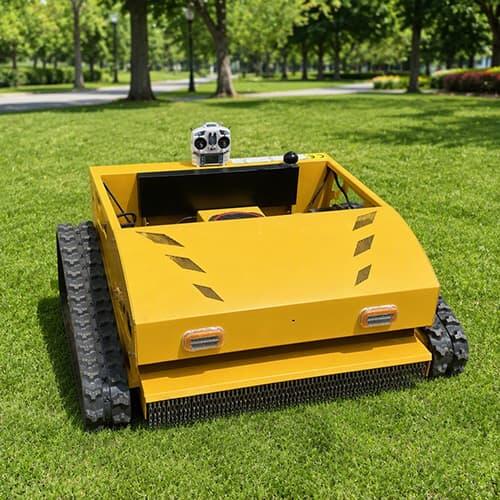
Going down is more dangerous than going up. The operator backs the machine down the slope — never drives forward down a steep face.
The remote is set to creep mode, capped at 30 percent throttle. The machine must descend under control without the tracks locking or the operator having to emergency-stop.
If the tracks skid or the machine picks up speed beyond walking pace, we inspect the hydrostatic bypass and the brake circuit.
A machine that runs away backward on a slope is a liability, not a tool. The descent test therefore looks at controlled movement rather than simply whether the machine can physically reach the bottom.
Once a week, after a rain, we rerun steps one through four on the damp section of the test slope.
This is where most failures show up. A machine that holds 32 degrees dry might slide at 22 on wet clay. The difference is not a theoretical number when the machine is working on actual ground.
We document the wet-condition limit for every unit and print it on the shipping placard.
Customers deserve to know the real number, not the brochure number. If a unit can't hold at least 25 degrees on wet grass, it doesn't get our slope-rated tag — it ships as a flat-ground machine only.
This is also why a single advertised maximum slope should not be treated as a complete description of a mower's working range. Surface condition can change the result substantially.
With the machine stopped at the fifteen-foot mark on the 32-degree face, the operator turns the remote off. Not the e-stop — powers it down completely.
Within two seconds, the machine must kill the blade clutch, return throttle to idle, and hold track position.
If it rolls backward more than one track length, the fail-safe circuit is rebuilt before retest.
We've rejected three units this year on this step alone. Signal loss on a hill isn't theoretical. It happens.
For a remote control lawn mower working on slopes, the fail-safe response needs to be tested on the actual machine rather than assumed from the transmitter specification. The machine has to demonstrate the expected response before it is released for shipment.
The last part isn't about the machine — it's about the person running it.
A different operator than the one who assembled the unit runs the full sequence. Fresh eyes catch things the builder misses.
Does the remote feel responsive on a slope? Can you read the battery indicator in sunlight? Does the machine pull to one side?
If the test operator flags anything, it goes back to the bench. We don't ship a machine that only one person can run cleanly.
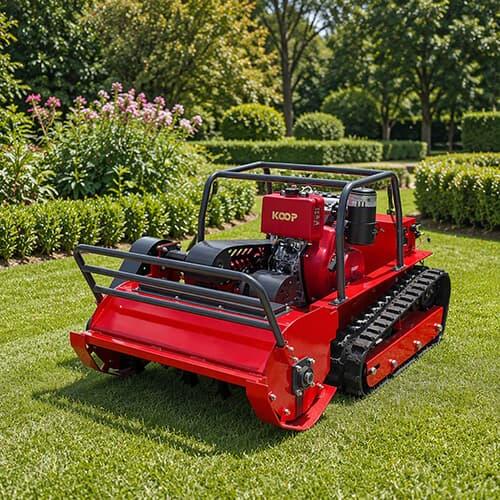
Every test run is logged with date, unit serial number, operator name, ambient temperature, ground condition (dry/wet), climb time, maximum rpm under load, track slip percentage, drift measurement, fail-safe response time, and a pass/fail stamp.
The log stays with the machine — printed, laminated, and tucked in the manual pouch. Customers can see exactly when and how their machine was tested.
For production quality control, this record is useful because it connects the test result to a specific unit rather than treating every mower as an identical number on a specification sheet.
About 8 percent of units don't pass on the first run. The most common reasons are listed below.
| Failure reason | First-run failure rate |
|---|---|
| Track tension out of spec | 3.0% |
| Drive motor pressure low | 2.0% |
| Fail-safe delay over 2 seconds | 1.5% |
| Blade deck drag on climb | 1.0% |
| Remote unresponsive beyond 200 ft | 0.5% |
Every failure is corrected and the unit is retested in full. No exceptions.
We've never shipped a unit that failed twice — if it fails twice, it gets stripped and rebuilt.
Customers buy these machines because they have hills that scare them. The least we can do is prove, on a real hill, that the machine won't be one of them.
For more real slope operation footage, you can also see our remote control mower testing and working videos.
If you are evaluating a tracked RC mower for steep terrain, wet ground or commercial slope work, you can contact our team through WhatsApp to discuss the terrain and machine configuration you need.
A real dirt slope introduces changes in clay, loose rock, grass, moisture and ground contact that a flat workshop or tilt platform cannot reproduce in the same way. Our test slope gives us a repeatable working environment for checking the machine before shipment.
The factory test slope described in this procedure is a 32-degree dirt face behind the assembly building. It is the reference terrain used for the seven-step test sequence. The actual working limit of an individual mower also depends on ground condition and the unit's documented test result.
Yes. The procedure calls for steps one through four to be repeated on the damp section of the test slope once a week after rain. Wet clay can produce substantially different traction from dry ground, so the wet-condition result is recorded separately.
The cause is inspected and corrected before the unit is tested again. The procedure covers track tension, drive pressure, fail-safe response, deck drag and remote performance among the recorded failure points. A unit that fails twice is stripped and rebuilt according to the stated procedure.
The remote is part of the operating system, particularly on slopes. The test checks responsiveness, battery visibility, signal behavior and fail-safe response. A mower may perform mechanically well while still requiring further attention to the control system.
The test record includes the date, unit serial number, operator, ambient temperature, ground condition, climb time, maximum rpm under load, track slip percentage, drift measurement, fail-safe response time and pass/fail result.
Get instant pricing, specs, and shipping details from our team.