
86 13686388557

Date:2026-09-23
Industrial mowing is not simply a product category. In practice, it is a way of moving risk away from the person working beside a rotating deck and toward a controlled remote operation from a safer position. The process starts with the first walk around the site and continues through machine selection, attachment matching, operator procedures and final handover.
The audit started at the gate with a clipboard and ended two hours later at a transformer compound. Five hazards made the list: a 1:2 batter alongside the access road, a drainage channel with a vertical drop, a stand of gorse hiding concrete rubble, an exclusion zone around a 33 kV switchboard, and a fire break that had not been cut in fourteen months. None of those five problems is solved simply by installing a larger engine.
The site record included slope angle in degrees at ten-metre intervals, surface type, debris load, clear line of sight from every cutting position, and a separate note for anything within three metres of live equipment. That last requirement alone ruled out a flail for one corner of the site.
Industrial terrain is almost never uniformly difficult. A site can be ninety per cent serviceable and still be defined by the remaining ten per cent. The decisive section may be loose shale over a thirty-degree slope, a rutted track or a steel cover plate. A wheeled zero-turn may perform well across the easier ground but become unsuitable on that critical section, while a tracked slope machine may move more slowly across the site but provide a more suitable solution for the difficult ground.
For this site, the split came out at roughly two thirds flat or gently sloping hardstand and one third batter, channel and gorse. That ratio pointed toward a tracked remote-control unit for the difficult one third, kept on a trailer, and a conventional ride-on mower for the hardstand. Buying one machine to cover both environments would have meant accepting compromises in both applications.
This is also where a tracked RC mower needs to be evaluated as part of the site system rather than only by its headline specifications. Track width, ground pressure, chassis balance, turning behaviour and the actual slope conditions should all be considered before a machine is assigned to industrial work.
A rotary deck is a poor answer to every type of industrial vegetation. On light grass and clean ground it can perform well, but once the material becomes stalky, woody or contaminated with rubble, the blades may ride over the material or encounter hard objects directly. This site had all three conditions, so the flail deck was selected.
Two characteristics made that choice practical rather than aspirational. First, the flail hammers pivot, so a buried lump of concrete can lift the hammer rather than transferring the full shock directly to the spindle. Second, the deck floats and follows the ground. On a rough batter, that ground-following behaviour can matter more than the exact hammer pattern.
There is a predictable trade-off. A flail deck generally costs more to service and can leave a coarser finish. For a fire break or rough industrial vegetation, however, those disadvantages may be less important than getting the area cut consistently without sending an operator onto the hazardous section.
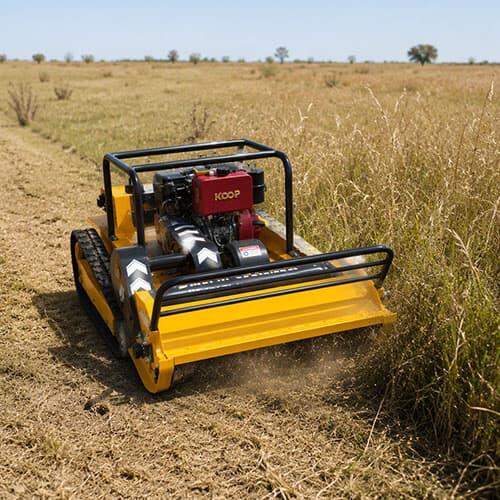
The transmitter is a critical part of the operating safety system, while the machine's mechanical controls and emergency devices provide additional protection. For this site, four requirements were made mandatory: a two-speed selector set to low for work inside an exclusion zone; a spring-return throttle so the machine returns toward a stopped or neutral state when the operator releases the control; an emergency stop that cuts both drive and blade operation; and a tested loss-of-signal response demonstrated before the first cut.
The loss-of-signal test was not treated as a paperwork exercise. The machine had to demonstrate the required response, with the cutting deck stopping before the tracks. This type of test should be carried out according to the machine's operating procedure and site requirements before working on difficult ground.
The line-of-sight rule is less impressive on a specification sheet but just as important in daily work. Two hundred metres of quoted range provides little practical value if a bund, storage tank or other obstruction sits between the operator and the mower. The site was therefore mapped around fixed standing points on the hardstand, and the operator was not permitted to work from behind sheet steel or a lorry.
For industrial applications, the useful question is not simply how far the remote control can reach. It is whether the operator can maintain a clear view of the machine, understand the terrain and intervene quickly when conditions change.
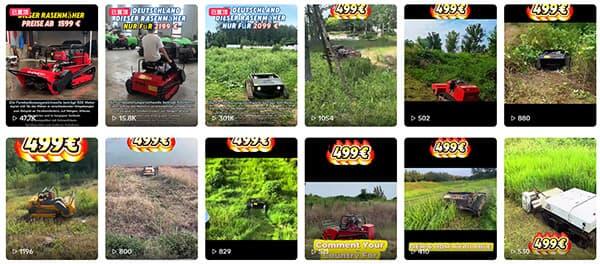
For examples of remote-control mower operation in different working environments, you can view our RC mower working videos on TikTok.
The handover included the slope map, hazard list, maintenance log, demonstrated loss-of-signal test, trained operator sign-off and a written exclusion perimeter for the switchboard corner. It also included a date for the next site audit.
That re-audit matters because industrial ground does not remain unchanged. Surfaces move, drainage channels collect sediment, fire breaks grow back and ground conditions can vary significantly between seasons. A slope that was manageable in March may present different traction or surface conditions in November.
Twelve months on, the measurable change was not simply the quality of the cut. Nobody had needed to set foot on the batter with a strimmer, and the vegetation programme had moved from “when we can get a man to it” to a fixed maintenance cycle.
That is the solution. Not simply a machine, but a repeatable working system that keeps people away from the dangerous part of the site while allowing the vegetation work to be scheduled and documented.
Audit the ground first. Choose the chassis for the worst metre rather than the average section. Match the deck to the material actually being cut. Make the remote operating procedure part of the safety system. Then document the work so the next crew inherits a system rather than a guess.
For industrial sites, this approach also makes equipment selection easier to discuss with an engineering or export team. A slope percentage alone is rarely enough. Surface type, debris, vegetation, access, line of sight, exclusion zones, cutting requirements and working cycle all affect the final configuration.
If you are planning a remote control mowing project for an industrial site, you can contact our team through WhatsApp to discuss the terrain, cutting conditions and machine configuration.
Industrial sites often contain several different hazards and surface conditions within the same property. A site audit identifies slopes, drainage channels, debris, exclusion zones, access conditions and line-of-sight requirements before the machine is specified.
The source example uses a tracked remote-control unit for the site's difficult batter, channel and gorse areas while using a conventional ride-on mower on the hardstand. The selection is based on the difficult section rather than the easier majority of the site.
The example site had stalky and woody material as well as areas contaminated with rubble. Pivoting flail hammers and a floating deck were considered more suitable for those conditions, although servicing requirements and finish quality are trade-offs.
Not necessarily. The source specifically highlights line of sight. A long quoted control range has limited practical value if a bund, storage tank, lorry or other obstruction blocks the operator's view of the machine.
The example handover included a slope map, hazard list, maintenance log, loss-of-signal test record, trained operator sign-off and a written exclusion perimeter. A date for the next site audit was also included.
Industrial ground conditions change. Drainage can alter, surfaces can move, vegetation can grow back and seasonal conditions can affect traction. A previous site assessment should therefore not automatically be treated as permanent.
Get instant pricing, specs, and shipping details from our team.