
86 13686388557

Date:2026-09-18
The Real Answer: Less Labour, More Inspection
It is the obvious question, and the honest answer is not a single number. A remote‑controlled mower saves hours of pushing and walking on steep slopes, but it still puts a cutting deck, a drivetrain and a power system through the same hard day out in the field. From our factory service records and conversations with commercial fleet operators, we see a clear pattern: the physical labour that used to belong to the operator on the hill simply shifts over to the workshop bench.
What follows is a practical picture of the time, the parts and the habits that keep an RC mower productive through a full mowing season.
Budget roughly two to four hours of maintenance per fifty operating hours, plus a longer service every two to three hundred hours. Add about thirty minutes at the end of each day for cleaning and checks. That is the working range for a typical tracked, slope‑capable RC mower.
Electric machines sit at the lower end of that range because there is no engine oil, no filters and no spark plug. Gasoline machines sit at the upper end, largely because of the additional service items tied to the internal combustion engine.
THE KEY POINT An RC mower does not maintain itself. It moves the effort from the slope to the bench, and trades physical labour for careful inspection.
Most expensive failures start as tiny, easy‑to‑miss issues: a track paddle worn smooth, a deck scraper missed during cleanup, a connector worked loose from constant vibration. The daily routine is exactly where these early warning signs get caught before they turn into breakdowns mid‑job.
| Check | What to look for | Typical action |
|---|---|---|
| Deck and blades | Caked grass, nicks, bent blades | Scrape deck, touch up or replace blades |
| Tracks and rollers | Missing paddles, cracks, oil on links | Replace worn track, clean rollers |
| Drive and deck belts | Cracks, glazing, slack | Tighten or replace belt |
| Pins and pivots | Play, rust, dry joints | Grease pivots, check pins |
| Remote and receiver | Antenna, LED, low battery, response | Charge transmitter, check range |
| Leaks and fasteners | Fuel, oil, hydraulic fluid, loose bolts | Top up, retighten to torque |
| Air intake and cooling | Grass in shrouds, blocked fins | Blow out with compressed air |
The single most valuable habit is cleaning the deck while it is still warm. Cold grass turns into hardened paste that corrodes steel and unbalances the blades. Ten minutes with a scraper at the end of the day prevents an hour in the workshop later. Many of our service tickets trace back to operators skipping this simple cleanup step.
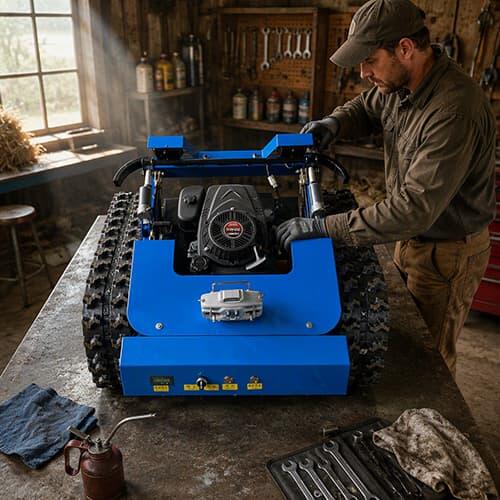
Every fifty operating hours the machine needs proper attention rather than a quick visual look. This is also the interval at which most warranties expect a complete service record, so keeping a logbook matters a great deal for fleet owners.
Gasoline models: Change the engine oil and the oil filter. Replace the air filter element. Check and gap the spark plug. Inspect the fuel filter and the fuel lines.
Electric models: Inspect battery terminals and connectors for corrosion or heat marks. Check the battery mounting and straps. Update the controller firmware if the manufacturer has released one.
Both types: Grease every grease point, retorque the blade and deck bolts, measure track sag, check belt tension, and test the loss‑of‑signal stop with the machine safely blocked up off the ground.
WHY 50 HOURS A remote mower spends more of its life tilted, shaken and caked in grass than a ride‑on does. Fifty hours of that treatment is a genuine service interval, not a suggestion.
Most of the annual parts budget goes to a small list of high‑wear components. Knowing what wears fastest is what keeps a machine earning instead of sitting idle waiting for courier deliveries. We advise all our export customers to keep these wear items in stock onsite.
| Part | Typical life | What signals replacement |
|---|---|---|
| Cutting blades or flail hammers | 20 to 50 hours depending on ground | Nicks, thin edges, vibration |
| Drive tracks | 200 to 500 hours | Missing paddles, cracks, exposed cords |
| Drive and deck belts | 150 to 300 hours | Cracks, glazing, slipping |
| Air filter element | 50 to 100 hours | Discolouration, difficulty starting |
| Engine oil and filter | 50 hours | Dark, thin or contaminated oil |
| Rollers and idlers | One to two seasons | Rough spin, play, noise |
Blades are the biggest variable. Rocky ground or old pasture can take an edge off in a single day. Keeping a spare set sharpened and balanced turns a mid‑morning failure into a ten‑minute swap. If you want to see real wear‑part comparison footage from our field tests, check out our videos posted on our TikTok channel.
| Task | Gasoline RC mower | Electric RC mower |
|---|---|---|
| Engine oil | Change every 50 hours | Not applicable |
| Filters and plug | Air, fuel, oil filter plus plug | None |
| Fuel system | Stale fuel, lines, carburettor | Not applicable |
| Battery pack | Not applicable | Health checks, terminal care |
| Drive and deck | Identical checks and greasing | Identical checks and greasing |
| Electronics | Basic check | Firmware and connector checks |
The common mistake we keep seeing from new buyers is to assume an electric machine needs no maintenance. It still has tracks, rollers, belts, blades, pins and a deck. Those parts wear in exactly the same way under tough slope conditions. The maintenance saving is real, but it comes entirely from eliminating engine service items, not from the whole machine being maintenance‑free.
Once a year, usually at the end of the mowing season, the machine should be gone over properly before storage.
Drain fuel or add stabilizer, then run the engine dry on gasoline models.
Remove, clean and balance the blades or replace the flail hammers.
Deep clean inside the deck and treat any paint chips to stop corrosion.
Check the frame, welds, the roll bar and the mounting brackets.
Service or replace the remote transmitter batteries and check the antenna.
Store the machine dry, on level ground, with the battery removed and charged to storage level.
STORAGE NOTE Long storage is where rubber ages and corrosion starts. A machine parked for six months needs a battery check, a fuel check and the tracks moved a few inches so they do not develop flat spots.
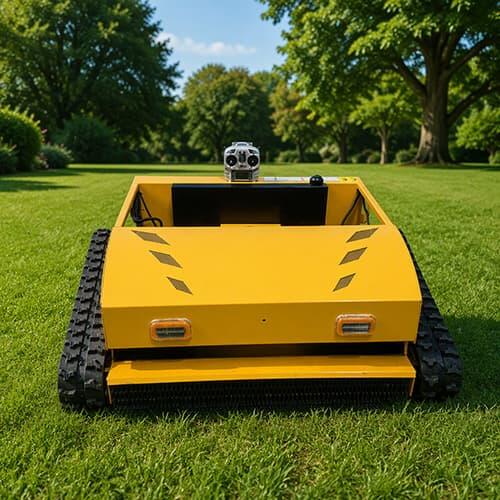
The difference between a machine that lasts multiple seasons and one that spends every spring stuck in the workshop is almost never a higher‑grade replacement part. It is a logbook and a few fixed daily service habits we recommend during our factory training sessions.
Write the hours down after every shift, and before every service.
Keep spare blades, belts and a track repair kit on the trailer.
Fix the small rattle today; it is cheaper than the broken part tomorrow.
Follow the torque figures in the manual, especially on blade bolts.
Test the loss‑of‑signal stop at the start of every shift.
So the realistic answer is this: an RC mower needs roughly half an hour a day, a proper look every fifty hours, and a thorough service once a season. Do that, and the machine will outlast the warranty. Skip it, and the first expensive failure is only a matter of time. You can view different tracked RC mower unit options on our Made‑in‑China store page.
BOTTOM LINE Maintenance on an RC mower is not difficult. It is just unforgiving of being forgotten.
If you would like to go over maintenance schedules or wear‑part recommendations for your RC mower fleet, reach our engineering team via WhatsApp.
Get instant pricing, specs, and shipping details from our team.