
86 13686388557

Date:2026-07-15
Choosing the right lawn mower is more complex than ever. Years ago, homeowners simply had to choose between gas-powered and electric models. Today, however, remote control lawn mowers have entered the market; they offer greater safety and efficiency, and can handle terrain that traditional machines cannot manage.
If you're wondering whether it's worth upgrading from a traditional push mower to a modern remote control crawler mower, the answer depends on far more than price alone. Factors such as mowing area, terrain, labor costs, safety requirements, and long-term maintenance all influence which machine delivers the best value.
This guide compares the two types of lawnmowers across key aspects—including efficiency, operating costs, safety, maintenance, terrain adaptability, and long-term investment—to help you make an informed purchasing decision.
A traditional push mower relies on manual effort to move across the lawn. Whether powered by gasoline or electricity, the operator must continuously walk behind the machine while controlling speed, direction, and cutting quality. These mowers have remained popular for decades because they are inexpensive, mechanically simple, and suitable for small residential lawns.
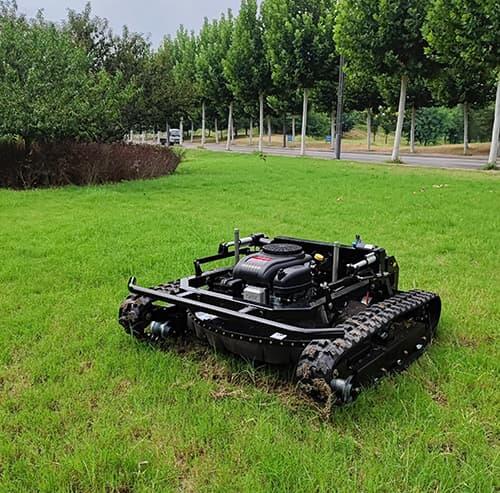
remote control lawn mower allow operators to control the machine from a safe distance using a wireless controller. Most commercial models feature tracks, powerful engines or hybrid systems, and intelligent safety features, enabling them to operate on steep slopes and rugged terrain, as well as in orchards, solar farms, along riverbanks, and in other challenging environments.
Commercial landscaping companies increasingly prefer remote-controlled mowers because they reduce labor costs, improve operator safety, maintain consistent mowing quality, and significantly increase productivity on large or hazardous sites.
The most noticeable difference between these two machines is the amount of physical effort required.
Operating a push mower means walking continuously behind the machine while steering, turning, and pushing over every part of the lawn. During hot weather or long working sessions, operator fatigue quickly becomes a limiting factor. Even on relatively flat lawns, mowing several hundred square meters requires considerable physical effort.
A remote control mower completely changes this experience. Instead of pushing heavy equipment, the operator simply guides the machine using a handheld controller while standing in a comfortable and safe position. Elderly users, property managers, and commercial operators can maintain large areas without exhausting themselves.
For businesses responsible for maintaining parks, industrial facilities, or municipal green spaces, reducing operator fatigue also means maintaining consistent productivity throughout the entire working day.
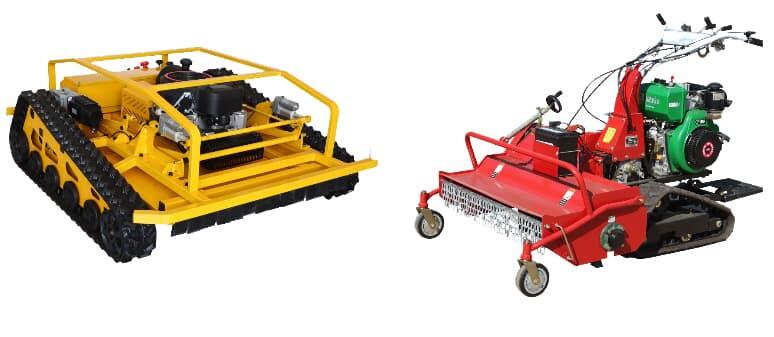
Efficiency becomes increasingly important as lawn size grows.
A push mower performs well on small residential lawns, but productivity declines as the operator tires. Walking speed becomes inconsistent, overlapping passes increase, and uneven cutting often requires additional work.
By comparison, commercial RC mowers maintain a constant travel speed and cutting height throughout the entire operation. Because the machine—not the operator—provides all propulsion, it can continue working efficiently for much longer periods without sacrificing cutting quality.
For landscaping contractors maintaining hundreds or even thousands of square meters every day, this improvement translates directly into lower labor costs and higher daily productivity.
Although a push mower may cost less initially, labor savings from a remote control crawler mower often recover the investment surprisingly quickly for commercial users who mow every week.
Terrain capability is where the performance gap becomes impossible to ignore.
Traditional push mowers perform best on smooth, level lawns with few obstacles. Once the ground becomes uneven, muddy, rocky, or steep, operation becomes increasingly difficult and physically demanding. Attempting to push a mower across a steep hillside not only reduces mowing quality but also increases the risk of slipping or losing control.
Modern remote control slope mowers are specifically engineered for these environments. Their low center of gravity, crawler-track design, and powerful traction systems allow them to work safely on slopes reaching 30°–45°, while also handling orchards, vineyards, riverbanks, solar farms, roadside embankments, and rugged commercial properties.
Watch real customer projects and commercial demonstrations on our official TikTok channel.
▶ Watch Real Working VideosSafety is one of the biggest reasons why many homeowners, landscaping companies, and municipal contractors are switching to remote control lawn mowers. Traditional push mowers require operators to remain directly behind the machine throughout the entire mowing process. This means they are constantly exposed to rotating blades, flying debris, engine heat, vibration, and the possibility of slipping on uneven terrain.
The risks become even greater when mowing hillsides. Losing balance while pushing a mower uphill or downhill can easily result in serious injuries or machine rollovers. Wet grass, loose gravel, and hidden holes further increase the chance of accidents.
A remote control crawler mower removes the operator from these dangerous situations. Instead of walking beside rotating blades, users control the machine from a safe distance while maintaining full visibility of the working area. Modern commercial models also integrate multiple intelligent protection systems, including emergency stop buttons, signal-loss shutdown, automatic braking, rollover protection, and engine safety monitoring.
Human-machine separation keeps operators away from rotating blades.
Safer operation on slopes, embankments, and uneven terrain.
Emergency stop and signal-loss protection improve workplace safety.
Less physical fatigue means fewer operator mistakes during long working hours.
At first glance, a traditional push mower appears to be the more affordable option. Entry-level residential models cost significantly less than professional RC mowers, making them attractive for homeowners with limited budgets.
However, the purchase price tells only part of the story. After several years of regular mowing, factors such as labor costs, maintenance time, lost productivity, and operator fatigue become real costs that must be considered.
For commercial landscapers or property maintenance companies, labor is often the largest operating expense. A single remote control slope mower can replace much of the manual effort required with traditional equipment, allowing workers to complete more projects each day while reducing physical strain and workplace injuries.
Although the initial investment is relatively high, many companies can recover their purchase costs in a relatively short period of time by improving efficiency and reducing labor costs.
| Feature | Traditional Push Mower | Remote Control Lawn Mower |
|---|---|---|
| Physical Effort | High | Very Low |
| Large Area Efficiency | Average | Excellent |
| Steep Slope Capability | Poor | 30°–45° |
| Safety | Operator exposed | Remote operation |
| Labor Cost | High | Low |
| Best Application | Small flat lawns | Residential & commercial complex terrain |
A traditional push mower remains a practical option if you own a small, flat lawn under approximately 300 square meters and only mow occasionally. Its simple mechanical structure, affordable purchase price, and straightforward maintenance make it suitable for basic residential lawn care.
If you regularly maintain large properties, steep hills, orchards, vineyards, solar farms, roadside embankments, or commercial landscapes, investing in a remote control crawler mower offers significantly greater value. Higher efficiency, improved safety, reduced labor requirements, and better cutting consistency make it the preferred choice for professional users.
Push mowers remain suitable for small residential lawns.
Remote control lawn mowers dramatically reduce physical labor.
RC mowers provide superior safety on difficult terrain.
Commercial users benefit from lower long-term operating costs.
Modern crawler mowers easily outperform push mowers on slopes and rough ground.
For homeowners with flat lawns, a traditional push mower may still be sufficient. However, if you maintain large properties, steep slopes, orchards, vineyards, or commercial landscapes, a remote control lawn mower quickly pays for itself through reduced labor costs, higher productivity, and much safer operation.
In most situations, yes. Modern remote-controlled crawler mowers handle everything from residential lawns to rough commercial terrain. Their ability to work on hillsides, wet grass, and uneven ground makes them far more versatile than conventional push mowers.
A remote control slope mower is considerably safer because the operator remains several meters away from the machine. Combined with crawler tracks, emergency stop functions, and automatic protection systems, it dramatically reduces the risk of slips, rollovers, and blade-related injuries.
Both machines require regular blade cleaning and inspections. Traditional push mowers have a simpler mechanical structure, while RC lawn mowers also require battery care, track inspection, and routine maintenance. When maintained properly, commercial RC mowers provide excellent long-term reliability and significantly lower operating costs.
The comparison between Remote Control Lawn Mower and traditional push-type lawn mowers ultimately depends on your lawn maintenance needs and long-term goals. For small residential lawns with low maintenance requirements, a push-type lawn mower remains an economical and practical solution.
However, for anyone responsible for maintaining steep hills, large properties, orchards, vineyards, municipal green spaces, or commercial landscaping projects, a remote control crawler mower offers clear advantages in safety, productivity, operating comfort, and overall return on investment.
With the continuous development of landscaping technology, intelligent lawn mowing devices are gradually replacing traditional manual mowing methods. Investing in a suitable machine today can not only reduce labor costs and improve lawn mowing quality, but also make it easier to maintain complex terrains in the coming years.
Whether you're looking for a remote control lawn mower, a slope mower, or a heavy-duty crawler model for commercial applications, our team can recommend the most suitable solution based on your terrain, working area, and budget.
📲 Get a Free Quote on WhatsAppFast Response • Factory Direct Pricing • Worldwide Shipping • OEM & ODM Available
Get instant pricing, specs, and shipping details from our team.