
86 13686388557

Date:2026-07-10
The global landscaping industry is entering a new era of intelligent equipment. With the continuous expansion of infrastructure projects and the increasingly severe shortage of labor, the demand for professional remote control lawn mower machine solutions has rapidly increased in areas such as municipal maintenance, solar power plants, vineyards, orchards, road embankments, and commercial landscaping projects. Equipment that was once considered a niche product has now become an important investment for enterprises responsible for safely and efficiently maintaining complex terrains.
According to recent industry forecasts, the global slope mower market is expected to maintain steady growth throughout the coming decade. Rising safety standards, increasing labor costs, environmental regulations, and digital transformation are accelerating the replacement of traditional walk-behind and ride-on mowers. Today, professional remote control crawler lawn mower technology is setting new benchmarks for productivity, operator safety, and long-term operating costs.
Rather than simply improving cutting performance, manufacturers are investing heavily in intelligent navigation, stronger climbing ability, energy-efficient power systems, and advanced safety technologies. The result is an entirely new generation of commercial RC mower equipment capable of handling environments that conventional machines simply cannot reach.
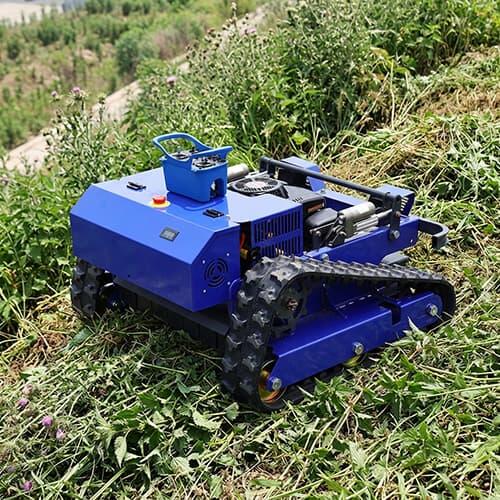
Just a few years ago, mowing grass on slopes was still heavily dependent on manual labor. Workers had to carry handheld grass-cutting machines or operate riding lawn mowers, facing dangerous slopes, unstable ground and unpredictable weather. Besides the strenuous physical labor, the company also faced rising insurance costs, work-related accidents and unstable project quality.
Today's commercial clients demand far more from lawn mowing equipment than basic cutting performance. Contractors require machinery capable of operating safely on steep embankments, maintaining high efficiency during extended use, and minimizing downtime caused by maintenance or operator fatigue. These new requirements are driving rapid technological innovation across the entire landscaping equipment industry.
One of the biggest changes in recent years is the expansion of application scenarios. Modern crawler mower equipment is no longer limited to municipal lawn maintenance. Professional buyers now use remote-controlled mowing systems for photovoltaic power stations, wind farms, vineyards, orchards, reservoirs, highways, airports, parks, and ecological restoration projects where traditional machines cannot operate efficiently.
As these industries continue to expand globally, equipment manufacturers are shifting from producing general-purpose mowers to manufacturing highly specialized commercial machines designed for specific industries and terrain conditions. This specialization has become one of the most powerful drivers of continuous product innovation.
For real commercial working demonstrations, visit ourofficial TikTok channel, where customers can watch professional hillside mowing projects using our latest commercial equipment.
Large-scale infrastructure construction has significantly increased the demand for professional slope maintenance equipment. Solar power plants are usually built on steep mountainous terrain and require regular vegetation control. Road embankments, railway corridors, reservoirs and industrial parks also need to be mowed continuously throughout the year to ensure safety and clear visibility.
The traditional mowing methods are ineffective in these environments due to their limited climbing ability, high risk of overturning, and the need for a large number of workers. As the project scale continues to expand, remote-controlled mowing equipment has become the preferred solution for contractors seeking higher productivity and lower operating costs.
In Europe, North America, and many other regions, finding experienced landscaping workers has become increasingly difficult. Meanwhile, wages continue to rise, and governments are tightening workplace safety regulations. As a result, companies are investing in automation to reduce reliance on manual labor while maintaining project quality.
One operator using a professional slope mower can safely complete work previously requiring multiple workers on dangerous terrain. Besides lowering labor costs, remote operation greatly reduces fatigue while improving consistency across large maintenance projects.
The most significant transformation in the slope lawn mower industry may lie in the rapid improvement of workplace safety. Traditional steep slope mowing operations often expose operators to risks such as slipping, machine tipping, flying debris, and prolonged physical exhaustion. As governments enact stricter occupational safety regulations, contractors are increasingly prioritizing equipment that minimizes personnel exposure to hazardous environments.
Modern remote control crawler lawn mower systems allow operators to remain safely away from hazardous terrain while maintaining complete control of the machine. Intelligent emergency stop systems, automatic signal-loss protection, tilt monitoring, obstacle detection, and low-center-of-gravity chassis designs have become standard features on commercial-grade equipment.
These technologies not only reduce accidents but also help enterprises lower insurance costs, enhance project compliance, and meet increasingly stringent government safety requirements. For contractors participating in municipal or infrastructure project bids, advanced safety systems have become a significant competitive advantage rather than an optional feature.
Another major innovation driven by market demand is intelligent automation. Early remote-controlled mowers relied entirely on the operator's experience, whereas modern commercial machines integrate advanced electronic components, simplifying operation while enhancing efficiency.
Manufacturers are introducing GPS positioning, intelligent route planning, real-time machine monitoring, remote diagnosis, and cloud based fleet management systems. These technologies enable contractors to monitor multiple machines simultaneously and collect valuable operational data, thereby helping to reduce downtime and improve maintenance plans.
Artificial intelligence is expected to play an even larger role over the coming years. Future commercial RC mower platforms will likely perform autonomous mowing, automatically detect terrain changes, optimize travel paths, and adjust cutting parameters without continuous operator input.
Environmental regulations are another powerful force shaping the industry's future. Governments worldwide continue to advocate for reduced emissions, lower operating noise, and more sustainable landscaping practices. Consequently, manufacturers are investing heavily in electric and hybrid systems to lower fuel consumption without compromising productivity.
High capacity lithium batteries, efficient brushless motors, and hybrid engine technology enable professional lawn mowing equipment to operate for longer periods of time while producing less noise and emissions than traditional gasoline engines. These improvements are particularly important for municipal parks, residential areas, schools, hospitals, and environmentally sensitive areas.
Businesses looking for professional manufacturing capabilities can also explore ourAlibaba International Storeto learn more about our commercial remote-controlled mowing solutions.
Commercial users expect equipment to operate reliably under demanding conditions for thousands of working hours. This expectation has encouraged manufacturers to redesign nearly every major component. Reinforced steel chassis, weather-resistant electrical systems, modular cutting decks, heavy-duty crawler tracks, and corrosion-resistant coatings all contribute to significantly longer equipment lifespans.
Maintenance has also become much easier. Modern designs allow operators to replace blades, tracks, filters, and wearable components more quickly, reducing downtime during busy mowing seasons. Lower maintenance requirements directly improve equipment utilization and increase overall return on investment for commercial operators.
| Industry Driver | Innovation Direction | Commercial Benefit |
|---|---|---|
| Labor shortage | Remote operation & automation | Lower labor costs |
| Safety regulations | Intelligent protection systems | Reduced workplace accidents |
| Complex terrain | Improved crawler technology | Higher slope capability |
| Environmental policies | Electric & hybrid power | Lower emissions & noise |
| Commercial competition | Fleet management & AI | Higher productivity |
The rapid expansion of the global slope mower market shows no signs of slowing down. As governments continue investing in renewable energy, transportation infrastructure, and environmental restoration projects, demand for professional remote-controlled mowing equipment will continue to rise. Manufacturers are therefore focusing on developing machines that are not only more powerful, but also smarter, safer, and easier to maintain.
Artificial intelligence is becoming one of the biggest drivers of innovation. Future remote control lawn mower platforms will gradually integrate GPS positioning, RTK navigation, intelligent route planning, obstacle recognition, and automatic terrain analysis. Instead of manually controlling every movement, operators will simply assign a mowing area while the machine automatically plans the most efficient working route. This technology will significantly improve productivity on solar farms, highways, airports, vineyards, and other large commercial maintenance projects.
Electrification is another important industry direction. Although gasoline-powered equipment still dominates heavy-duty applications, lithium battery technology continues to improve rapidly. Longer battery life, faster charging speeds, and high-efficiency brushless motors are making electric and hybrid commercial mowers increasingly attractive for contractors seeking lower operating costs and reduced emissions.
Product specialization is also accelerating. Instead of manufacturing one universal machine, equipment suppliers now design dedicated models for vineyards, orchards, photovoltaic power stations, municipal landscaping, forestry management, and highway maintenance. Different cutting systems, chassis structures, crawler tracks, and intelligent control software allow every model to achieve higher productivity within its target working environment.
Commercial customers also expect greater equipment durability than ever before. Modern remote control crawler lawn mower models increasingly feature reinforced steel frames, corrosion-resistant coatings, fully sealed electrical systems, heavy-duty crawler tracks, and modular structures that simplify routine maintenance. These improvements reduce downtime while extending the overall service life of the machine, ultimately lowering total ownership costs.
Digital fleet management is another growing trend. Large landscaping companies often operate multiple machines simultaneously across different job sites. Cloud-based monitoring systems allow managers to track operating hours, maintenance schedules, equipment locations, battery status, fuel consumption, and productivity statistics in real time, making commercial fleet management more efficient than ever before.
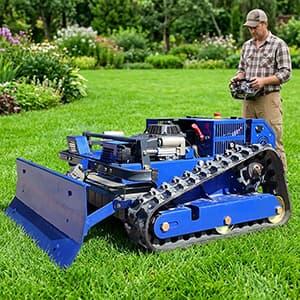
Continuous innovation benefits everyone involved in commercial landscape maintenance. Contractors can complete projects faster while reducing labor costs. Municipal maintenance departments improve workplace safety and reduce accident risks. Vineyard and orchard owners gain precise vegetation control without damaging valuable crops, while infrastructure operators maintain difficult slopes more efficiently throughout the year.
Competition among manufacturers is also improving product quality. Buyers now enjoy more advanced safety systems, longer warranties, stronger technical support, and better spare parts availability than ever before. Instead of simply purchasing a mower, commercial customers increasingly receive complete long-term maintenance solutions supported by professional after-sales service.
To learn more about our commercial remote-controlled mowing equipment, visit ourMade-in-China Official Storefor detailed product specifications and international business inquiries.
The primary drivers include expanding renewable energy projects, increasing municipal landscaping investments, labor shortages, rising labor costs, and stricter workplace safety regulations. Professional remote-controlled slope mowers solve many challenges that traditional mowing equipment cannot handle efficiently.
Artificial intelligence, GPS navigation, autonomous mowing, brushless electric drive systems, intelligent obstacle detection, cloud fleet management, and advanced safety monitoring are becoming the core technologies shaping the next generation of commercial slope mowers.
Electric machines continue gaining popularity because they produce less noise, require less maintenance, and generate lower emissions. However, gasoline and hybrid machines remain the preferred choice for large commercial projects requiring maximum endurance and continuous heavy-duty operation.
Remote-controlled slope mowers are widely used in municipal landscaping, highway maintenance, vineyards, orchards, solar farms, wind farms, reservoirs, parks, golf courses, airports, and many other commercial vegetation management projects involving complex terrain.
The global demand for professional slope lawn mowers is constantly growing, accelerating innovation in the landscaping equipment industry. Compared with traditional lawn mowing equipment, modern remote-controlled lawn mowers have higher safety, stronger terrain adaptability, lower operating costs, and higher production efficiency. The continuous progress in automation, intelligent control, energy efficiency, and professional product design is changing the way commercial vegetation maintenance is carried out.
As infrastructure development and environmental management projects continue expanding worldwide, professional crawler mower solutions will become even more important. Companies investing in advanced remote-controlled mowing technology today will be better prepared to improve project efficiency, reduce labor costs, strengthen workplace safety, and remain competitive in the rapidly evolving landscaping industry.
Get instant pricing, specs, and shipping details from our team.