
86 13686388557

Date:2026-09-15
On a Monday morning, a contractor has two nearly identical remote-control slope mowers in the yard. One carries a 48-volt battery pack. The other carries a four-stroke engine and a five-gallon fuel can. Both will cut the same grass. The difference shows up everywhere else: how the day is scheduled, how the crew travels between sites, and what the operator feels at the end of a ten-hour shift.
The right answer is not necessarily the machine with the biggest number on the specification sheet. It is the machine whose power source matches the work between refuelling or recharging. That single point decides most of the practical choice.
It also matters that battery and gas machines are increasingly capable of similar cutting work. A modern 48- to 60-volt electric drive can hold a slope and pull a flail deck hard enough that the cutting result is no longer the main differentiator. What separates the two machines is everything that happens before the blades turn and after they stop. That is where this guide stays focused.
A battery RC mower runs on stored electrical energy. When the pack reaches its working limit, the machine stops until the battery is swapped or recharged. A gas RC mower can continue working as long as fuel is available and the engine remains in operating condition. That basic difference creates a long list of smaller differences in daily use.
The distinction shows up first in scheduling. A battery machine asks the operator to think about the next charging point in much the same way a gas machine requires planning for the next fuel stop. The crew that builds this into the route can operate either machine effectively. The crew that ignores it will eventually struggle with either one, but the consequences are usually more obvious with a battery machine.
The practical split comes down to three patterns of work:
Short-cycle work: repeated short visits close to a charging point.
Long-shift work: all-day cutting far from any outlet.
Mixed work: a combination of both, often changing from one week to the next.
THE SPLIT If the machine returns to base every hour or two, battery power is usually the simpler answer. If it must run for five or six hours continuously in the field without a practical battery swap or charging opportunity, gas remains the safer default.
| Factor | Battery (electric) | Gas (engine) |
|---|---|---|
| Startup | Instant, push-button | Pull-start or key, warm-up |
| Running cost | Low per hour, electricity only | Fuel + oil + filters |
| Noise & emissions | Quiet, zero on-site emissions | Loud, exhaust emissions |
| Maintenance | Few moving parts, no oil changes | Engine servicing, carburettor, spark plug, belts |
| Peak power / torque | Strong low-end, can fade as pack drops | Steady under load until fuel runs low |
| Weight | Heavy pack, fixed low in chassis | Engine weight higher, fuel sloshing |
| Weather sensitivity | Cold reduces range; battery needs care | Cold starts harder; fuel remains stable |
| Range / runtime | Limited to pack + swap/charge time | Limited mainly by fuel on hand |
| Operator comfort | No fumes, far less vibration | Heat, fumes, more vibration |
Battery power is at its best when the work is local, repetitive, and close to a charger. That covers a significant amount of slope maintenance. Municipalities, campuses, and contractors with a central yard often find that many of the slopes on their route are within a relatively short drive of base. In that situation, a battery swap or charging period can fit naturally into the existing work routine.
Noise windows: Schools, hospitals, offices, and quiet neighbourhoods may restrict engine noise. A battery machine can make it easier to work within those operating windows.
Site access: Indoor barns, covered yards, and enclosed spaces can make engine exhaust impractical. Battery power opens up applications where ventilation is a concern.
Operator comfort: No exhaust fumes, less engine heat, and much less vibration can make a noticeable difference over a full working day.
Service simplicity: There are no routine oil changes, fuel stabiliser, carburettor servicing, or spark-plug replacement. A charged pack and a normal machine inspection are generally all that is needed before starting the workday.
The common thread is not simply cutting performance. It is the removal of work around the machine. There is no fuel to transport or spill, no engine to winterise, and no engine noise affecting nearby users. Across a full season, those smaller advantages can become significant for a crew operating several machines.
BATTERY ADVANTAGE Battery does not beat gas on raw range. Its advantage is everything that happens around the machine: noise, fumes, servicing, and the ability to deploy the mower without carrying fuel or depending on an engine mechanic for routine operation.
Gas stays ahead wherever the work is long, remote, or heavy. A fuel can is a simple, portable energy store that does not depend on the electrical grid or a charging window. That independence matters on rural routes, highway corridors, and large properties where bringing charging equipment or waiting for a battery to recharge is not practical.
Continuous all-day cutting on large, remote slopes.
Heavy brush and thick growth that keeps the cutting system under load.
Cold storage and long periods of inactivity between seasons.
Sites with no reliable power for charging infrastructure.
None of this means gas is outdated technology that should automatically be replaced. It means gas is optimised for a different shape of work. On a route with long, uninterrupted cuts and no practical power source, a gas RC mower can still be the more relaxed tool to operate. The trade-off is maintenance and noise, but both are predictable parts of running an engine-powered machine.
GAS ADVANTAGE A five-gallon fuel can is still one of the most portable energy sources on a jobsite. Until a battery platform can provide the same level of field flexibility without adding significant charging infrastructure or spare-pack cost, gas remains the natural long-shift choice.
Every power source has limits, and those limits become much more noticeable after a full working season than they do during a short demonstration. For an RC mower, the right question is not which system has fewer disadvantages. It is whether those limitations fit the route, weather and working schedule.
| Limit | Battery | Gas |
|---|---|---|
| Cold weather | Range drops; battery needs care | Cold starts harder; fuel stable |
| Recharge time | Adds downtime or needs spare packs | Refuel in minutes anywhere |
| Battery life | Packs age and eventually replace | Engine rebuild possible, familiar |
| Weight & balance | Heavy pack low in chassis | Engine mass higher, fuel sloshes |
None of these points automatically rules out either type of mower. They become important when matched against the actual working season. A battery pack may perform differently in cold conditions, while a gas engine may need more attention before starting after long storage. Likewise, recharge time only becomes a serious limitation when the route cannot provide a suitable charging window.
When we evaluate a power system for a remote control lawn mower, we look beyond the rated capacity and ask how the machine will actually be used. The route length, cutting load, number of working hours and access to the charging or refuelling point usually tell us more than a single figure on a specification sheet.
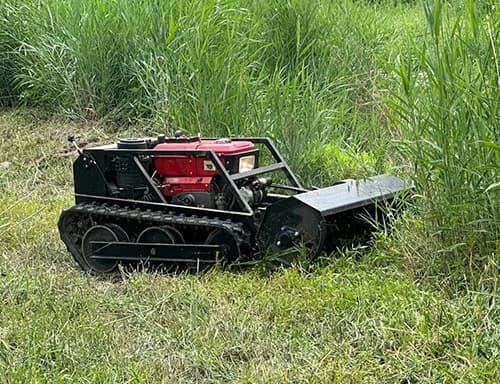
For mixed work, a two-battery setup can be a practical middle ground. One pack powers the machine while the second is charging or ready for the next working cycle. The initial equipment cost is higher, but the operator can keep the advantages of an electric tracked mower without accepting a full production stop every time the first battery reaches its limit.
This arrangement works best when the route returns to the base within the practical runtime of one pack. The second pack and charger also need to be included in the operating budget from the beginning. In our experience with machine configuration, battery capacity should be considered together with the charging system rather than treated as a separate accessory.
The route returns to base within the practical runtime of one battery pack.
A second battery pack and suitable charger are included in the equipment budget.
Battery swaps and charging periods are planned as part of the daily work schedule.
There is also a practical service advantage. If one pack develops a problem, the second pack can keep the machine working while the faulty unit is inspected. That does not remove the need for proper battery management, but it reduces the chance that one battery issue stops an entire day's work.
DUAL-BATTERY RULE: Two packs can be more useful than one larger pack. The mower keeps cutting while the spare charges, and a single failed pack does not necessarily end the working day.
For operators comparing configurations, seeing the actual machine working is often more useful than comparing battery numbers alone. Our RC mower working videos show different working conditions and machine configurations in real operation.
Does the route return to a charger every couple of hours? If yes, a battery machine becomes a realistic option because charging or swapping can be built into the working cycle.
Are there noise or fume restrictions? If yes, battery power can remove a major operating concern, particularly around residential areas, campuses and other noise-sensitive locations.
Is there a single job that runs longer than the practical battery runtime with no opportunity to swap? If yes, gas is usually the safer choice because refuelling can be done quickly without depending on a charging point.
Is there reliable grid power at the base? If not, a fuel can remains easier to transport and use wherever the machine is needed.
Battery power makes the most sense for short working cycles, noise-sensitive locations, indoor or enclosed applications, and operations where simple routine maintenance matters. Gas remains a strong choice for all-day remote slope work, heavy cutting, cold storage conditions and locations where reliable electrical power is not available.
For mixed operations, there is no need to force every machine into the same configuration. An electric RC mower can handle routes where the working pattern supports charging, while a gas machine can remain available for long days in remote areas. As battery systems and charging equipment continue to improve, that division can become even more practical.
The important point is to let the work schedule decide rather than choosing from a brochure. Before replacing an existing mower, write down the longest uninterrupted cutting period and the distance from the working area back to the charging point. Those two numbers usually narrow the choice much faster than a long feature list.
For a specific application, configuration also matters. Cutting width, flail deck load, slope conditions, battery capacity and expected daily working hours should be considered together. If you want to compare a suitable remote control lawn mower configuration for your working conditions, you can send us the route and expected working time.
BOTTOM LINE: Battery for work that comes home. Gas for work that stays out. For a mixed route, two battery packs can often be more useful than one bigger pack.
Yes, provided the machine is correctly configured for the slope, surface condition and cutting load. Battery power itself does not determine whether a tracked mower can work on a slope. Traction, machine balance, track design and the cutting system all have to be considered together.
For a long uninterrupted job far from a charging point, gas still has a practical advantage. A fuel can is easy to transport and refuelling takes only a short break, so the machine can continue working without waiting for a battery to recharge.
Cold conditions can reduce practical battery range, so operators working through winter should consider storage, charging conditions and the expected working cycle. The effect becomes more important when the normal route already operates close to the battery's available runtime.
Not in every application, but two swappable packs can be more useful for operations that need continuous production. One pack can work while the other charges, reducing downtime and providing some backup if a battery needs inspection or replacement.
Battery machines generally have fewer routine engine-related maintenance requirements and use electricity instead of fuel, but the total operating cost depends on the electricity rate, battery replacement cycle, charger investment and working schedule. Gas machines have fuel, oil and engine-service costs but offer convenient refuelling for long remote jobs.
Start with the longest uninterrupted cutting period rather than the motor specification. Then check whether the machine can return to a charging point during that period. If it can, battery becomes much easier to operate. If it cannot and the job is remote, gas remains a practical option. You can also contact our team for configuration advice based on your working conditions.
Get instant pricing, specs, and shipping details from our team.