
86 13686388557

Date:2026-10-08
Eight practical rules that keep the machine on the hill and the operator out of the danger zone
Steep-slope mowing is one of the jobs where a small mistake can cost much more than a few minutes of working time. A remote control unit gives the operator an important advantage by allowing them to work away from the machine, but it does not remove the physical risks created by gravity, poor traction or changing ground conditions.
A machine can still slide, tip or roll, and the operator can still end up in its path if they choose the wrong position. The following eight rules are built around the way a remote control lawn mower is actually prepared and operated on steep terrain.
Do not guess the slope angle. A hill you have walked many times can look shallower from the bottom than it really is, and once you are operating from behind the remote, visual judgment becomes even less reliable.
Carry a clinometer or smartphone inclinometer app and measure the slope at three points: the top, middle and bottom. Slopes are rarely uniform, so the steepest section should determine whether the machine is suitable for the job.
Compare the measured angle with the machine's published maximum operating limit. A machine rated for thirty degrees should not automatically be treated as suitable for thirty degrees under every condition. Wet grass, loose soil, worn tracks and other surface conditions can significantly reduce available traction.
If the actual reading is close to the manufacturer's stated limit, treat the conditions conservatively rather than assuming the machine will perform exactly as it does on a dry test surface. No mowing job is worth recovering a machine after a preventable rollover.
This is the rule that gets repeated until it sounds like nagging, and it is still one of the easiest rules to break when an operator is trying to finish a difficult section quickly.
Working horizontally across the slope keeps the machine's weight distributed across its tracks or tyres. Travelling straight uphill changes the load distribution, while travelling directly downhill can allow the front of the machine to dig in and the rear to lift.
Plan the mowing passes before starting. Pick a line, maintain it, and overlap the previous pass by approximately half a cutting width where the working method requires it.
When reaching the end of a pass, turn on flatter ground rather than making a sharp turn on the steepest section. If the slope is too long to cross in one pass, divide it into manageable sections and work each section deliberately.
For a tracked RC mower, the same principle applies even when the machine has strong traction. Tracks can improve ground contact, but they do not eliminate the effects of slope angle, surface conditions or poor operating direction.
Speed reduces the amount of time available to react when traction changes. Momentum can carry the machine beyond the point where the tracks or tyres can recover grip.
On a sidehill, use a controlled ground speed and avoid making sudden changes to throttle or direction. The source operating guidance recommends approximately half to two-thirds throttle for sidehill work, but the actual speed should remain within the machine manufacturer's operating instructions and should be reduced further when the surface becomes difficult.
Give the tracks time to maintain contact with the ground and give yourself time to react to changes in the surface.
The same principle applies to turns. Do not pivot or spin the machine in place on a slope. A tracked machine turning sharply can shift its load and lose traction quickly. Use a wider forward or reverse arc and, where possible, change direction on level ground.
A loss of radio signal is not something to discover for the first time halfway up a hill. Most commercial remote-control machines have a failsafe response, but the exact response varies by machine.
Before working on a slope, understand what your machine is designed to do when the transmitter loses contact. Depending on the system, the machine may stop driving, hold position or disengage the cutting system.
Test the response deliberately on flat ground. Stand close to the machine, switch the remote off and observe what happens. Do not assume that a failsafe works simply because the specification sheet says that one is installed.
It is also worth identifying signal dead zones around the property. Buildings, metal fencing, interference sources and some terrain features can affect communication. Walk the working area with the remote and note any locations where the signal becomes unreliable.
If a weak-signal area cannot be avoided, keep the machine in a position where a potential loss of control does not create a downhill run toward the operator.
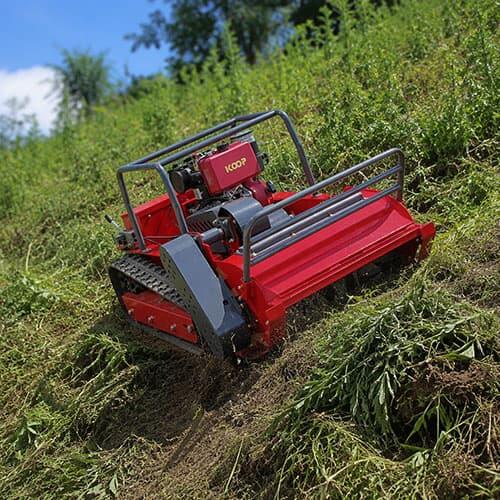
If you are comparing different remote control mower configurations, you can also view practical machine operation on our RC mower field videos.
Slope-related incidents can begin before the mower reaches the grass. A tracked machine sitting on a trailer has a different centre of gravity from a machine operating on the ground, and sudden braking or cornering can move an unsecured load.
Use ratchet straps at the manufacturer's designated anchor points rather than choosing convenient attachment locations. Check strap tension again after the first part of the journey because straps can settle or stretch during transport.
At the job site, unload on level ground whenever possible. Do not position the trailer on a slope simply because it is closer to the working area.
Never ride on the machine while it is being driven down a loading ramp under its own power. The space between a moving machine and trailer can become a serious crush hazard.
The same slope can behave very differently from one day to the next. Dew, rain, frost and thawing conditions all change the surface and therefore the available traction.
Wet grass can make a slope that was manageable in dry conditions much more difficult. Frost can make the surface slippery, while a recent thaw can leave loose material above a harder layer underneath. If the grass is wet enough to affect traction, wait for conditions to improve. If the soil is soft enough to move under your boots, postponing the job may be the more practical decision.
Wind also deserves attention. Crosswinds can make sidehill operation uncomfortable, while strong wind can move dust and debris across the operator's line of sight and interfere with working conditions.
The original field guidance uses approximately twenty miles per hour as a point at which to stop work because of flying debris and reduced visibility. Actual limits should also follow the manufacturer's instructions and the conditions at the site.
A proper pre-start inspection takes only a few minutes and can identify problems before the machine reaches the slope.
Check track tension and lug condition. Look for grass, stones or other debris packed between rollers. Confirm that blade bolts are tight and that the cutting deck is secure.
Inspect hydraulic lines for signs of leakage and check other visible hydraulic or drive components according to the machine's maintenance requirements.
Make sure the remote-control batteries are adequately charged. A transmitter with a low battery can become an avoidable source of intermittent control problems.
None of these checks is particularly exciting. On a steep slope, however, a small mechanical or control problem can have much greater consequences than it would on level ground.
For commercial operators, recording basic inspection findings can also help identify recurring problems with tracks, cutting components, belts, hydraulic lines or control equipment before they become larger maintenance issues.
The biggest practical advantage of a remote-control mower is that the operator does not have to sit on the machine. Do not give that advantage away by standing in the wrong place.
Stand to the side of the machine's line of travel and, where the terrain allows, position yourself uphill from the working area. Never stand directly below the machine.
If the machine loses traction and begins to slide, gravity will generally carry it downhill. Your position should therefore be chosen so that a potential slide does not move toward you.
Where the terrain permits, keep approximately thirty feet or more of distance between yourself and the machine. The extra distance can provide a better view of the working face while keeping the operator farther from the machine and thrown debris.
If the transmitter has a lanyard, use it. If it has a dead-man switch, use it as designed. These features only help when they are actually part of the operating routine.
For specific machine configurations, cutting widths and slope-mowing applications, you can contact our engineering team on WhatsApp for product information and operating details.
You can also review our remote control mower product range to compare different tracked mower configurations.
Measure first. Cut across the slope. Go slowly. Test the failsafe. Secure the machine during transport. Respect the weather. Check the machine before starting. Stand clear of the downhill path.
These are not eight unrelated rules. They are parts of one operating habit. The machine, terrain, weather, control system and operator position all affect the result, so skipping one check can undermine the others.
The contractors who continue working steep terrain successfully are not necessarily the ones who never encounter a difficult situation. They are the ones who build enough discipline into the job that avoidable situations are identified before they become recovery operations.
Measure the actual slope angle at several points and compare the steepest section with the machine manufacturer's published operating limit. Do not rely only on visual judgment or previous experience with the same property.
The operating method described here is to mow across the face rather than travelling directly uphill or downhill. Direction of travel should also remain within the machine manufacturer's operating instructions for the specific model and conditions.
Test it on flat ground before taking the machine onto the slope. Stand close to the machine, deliberately interrupt the remote connection according to the manufacturer's testing procedure, and confirm the machine's actual response.
Yes. Wet grass can substantially reduce available traction compared with dry conditions. If the machine is operating close to its rated slope limit, wet conditions can make the same slope unsuitable for the day's work.
The operator should remain outside the machine's likely travel path, preferably to the side and uphill where the terrain allows. Avoid standing directly below the machine, because a loss of traction can send the machine downhill.
Check track tension and condition, rollers, debris buildup, blade or hammer fasteners, deck security, visible hydraulic lines and remote-control battery condition. Follow the machine's own maintenance and inspection requirements as well.
Get instant pricing, specs, and shipping details from our team.