
86 13686388557

Date:2026-09-22
Predictions about outdoor power equipment usually age badly. Almost every trade show has an autonomous concept on display, while most crews are still working from flat ground above the bank, transmitter in hand. Rather than making a broad forecast, this article looks at six practical scenes that show where remote control slope mowing technology is heading and what each change could mean for the operator.
A contractor arrives at a property she has never worked on before. Instead of walking the boundary with spray paint, she walks the route with the mower at a controlled speed while the chassis records its path, deck height, slope angle and the sections where the tracks lose grip. That first recording becomes part of the job plan. On the next ten visits, the machine can follow the stored route. If a tree falls or a ditch changes, the operator only needs to re-record the affected section while the rest of the route remains available.
What changes: the expensive part of a slope job starts to shift from simply cutting grass to understanding and recording the ground. The operator's experience becomes part of the machine's working data rather than something that exists only in the operator's memory.
On a long, clean embankment, the remote control transmitter sits on the bonnet of the service truck. The machine is running a stored route, while the transmitter is mainly there for emergency intervention and the live video feed provides a view of the cutting area. A warning appears on the operator's phone: blade load is climbing on the lower third of the slope. He picks up the transmitter, drives that section manually for four minutes, marks it as a soft patch and then hands control back to the stored route.
What changes: a single operator could eventually manage several machines during a working day instead of staying beside one machine for the entire cutting cycle. The gain does not come simply from driving faster. It comes from reducing the amount of time the operator needs to remain directly beside a working mower.
For practical examples of remote-control mower operation and slope work, you can also see our remote control mower videos on TikTok.
A bankside that used to be skipped after rain is now tested with the mower. During the first traverse, the machine reports fourteen per cent track slip. The operator stops the job. Twenty years ago, that decision might have been made with boots on the slope. In a more connected RC mower, the decision can be made from the pavement above while the operator watches the machine's tilt and traction information. The site is then scheduled for a drier week.
What changes: fewer machines are committed to ground conditions that they cannot handle, and operators have more information before deciding whether to continue. Lower ground pressure may also become possible as battery packs become more compact and chassis centres of gravity are reduced. Even with better sensors, however, the operator's judgment remains the final decision on whether the ground is suitable for the machine.
A new petrol unit arrives at the yard with a liquid-cooled, low-revving engine governed to a steady operating speed. It is noticeably quieter, allowing the crew to start a residential job at seven without the same level of noise disturbance. On the slope, it still handles heavy material where the electric fleet cannot maintain a full shift, but it runs at a stable speed and temperature throughout the working day.
What changes: noise, rather than outright cutting power, becomes an increasingly important reason for electric equipment in residential areas. Quiet equipment may gradually move from being a premium feature to being a basic requirement for some working environments.
For current machine configurations and different power-system options, you can view our remote control mower range on Alibaba.
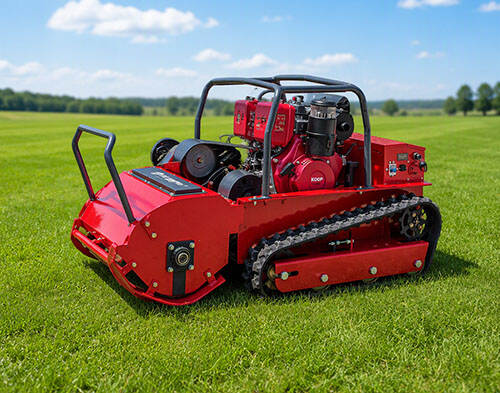
A crew arrives at a council site and the machine will not arm. Its last documented loss-of-signal test is thirty-one days old, while the site requires one test per month. The crew runs the test, records the result and starts forty minutes late. Nobody is hurt. The job loses some time instead of relying on luck.
What changes: operational requirements and site procedures become increasingly connected with the machine's control system. Instead of treating safety checks as a paragraph in a manual, future equipment may record whether required checks have been completed before allowing operation.
A first-week operator spends a morning in a simulator, a week working on flat ground and only then moves above a real bank with a mentor and a two-speed transmitter locked to low. Her first month is documented with operating hours, incidents and recovery events. By the second month, she is trusted with a site of her own, with the company's training record providing evidence of how she was prepared for the work.
What changes: the skill is no longer passed only from one experienced operator to whoever happens to be standing nearby. Training can become documented, repeatable and easier for a company to manage across different operators and sites.
For machine configuration, application questions or a discussion about a specific slope-mowing requirement, you can contact our engineering team through WhatsApp.
The technology does not remove the operator. It changes where the operator works and what the operator is responsible for. More of the work can move uphill from the immediate danger area, into the cab or service vehicle, into training rooms and eventually into a more centralized control environment.
For remote control lawn mower development, the important progress is therefore not simply making a machine drive by itself. Route recording, traction monitoring, power management, safety checks and operator training all have to work together. The machine may eventually spend more time in the place that once required a person to stand there, while the person remains in a position where decisions can be made with better information.
The direction described in these scenarios is toward greater route automation and operator assistance rather than removing human supervision completely. Slope conditions, obstacles and changing ground conditions still require decisions.
A recorded route could reduce repeated setup work on familiar sites. If ground conditions or obstacles change, the affected section could be recorded again rather than rebuilding the entire working route.
The article presents different operating conditions rather than a complete replacement. Noise can make electric equipment attractive for residential work, while high-load and long-shift applications may continue to require different power solutions.
A traction reading can give the operator an early indication that the ground is becoming unsuitable. This information can support the decision to stop rather than continuing until the mower loses too much grip.
That is one of the developments described in the article. A machine could potentially record required checks such as loss-of-signal tests and use that information as part of the operating procedure.
The training scenario points toward a combination of simulator practice, controlled flat-ground operation, supervised slope work and documented operating records. This could make training easier to repeat across a commercial team.
Get instant pricing, specs, and shipping details from our team.