
86 13686388557

Date:2026-09-28
Not a spec sheet. A short list of what actually earns its keep on a slope
A long feature list is easy to write and useless to buy from. The truth is that a slope machine only needs a handful of things to be right, and most of them have nothing to do with horsepower. Group them in order: the ones that keep you alive come first, then the ones that keep the machine alive, then the ones that let you finish the day, then the ones that keep money in your pocket.
If a brochure is strong on the last group and silent on the first, you're looking at the wrong machine. When we evaluate a remote control lawn mower or tracked slope mower for real work, this order is much more useful than simply comparing engine horsepower or cutting width.
These are not optional. If a machine lacks even one of them, it has no business on a slope with a person anywhere nearby.
— A fail-safe that has been demonstrated, not just claimed. The machine must do something specific and predictable when the signal vanishes — engine off, deck disengaged, drive locked. Read the words, then watch it happen on a stand. A label that says "safety system" without a demonstrated response is decoration.
— A physical emergency stop that works without the radio. There must be a hard-wired kill path independent of the receiver. Batteries die, antennas break, receivers flood. The e-stop has to kill the engine with the transmitter in pieces on the ground.
— A traction system that cannot drift downhill under power. Hydrostatic drivetrain with proper braking, or tracks with positive engagement. A wheeled machine that relies on a parking pawl to hold a 30-degree face is not a slope machine; it is an accident waiting for a gradient.
— A low centre of gravity before a high horsepower figure. Horsepower does not stop a rollover. Mass kept low and between the tracks or wheels does. This is why a modest 16-horsepower tracked unit can out-climb a 25-horsepower machine with a high-mounted engine and a tall deck. In practical slope work, chassis layout and weight distribution deserve attention before the engine number on the brochure.
— A roll-over protective structure with a certified attachment point. Not a bent tube welded on because it looked right. If you ever need a winch to recover the machine, the point you hook to must be the one the chassis was designed around, not the one that was handy.
For a remote-control slope mower, these first checks should be demonstrated rather than explained only through a specification sheet. You can also see how different tracked RC mower configurations are presented in practical operating conditions on our RC mower video channel.
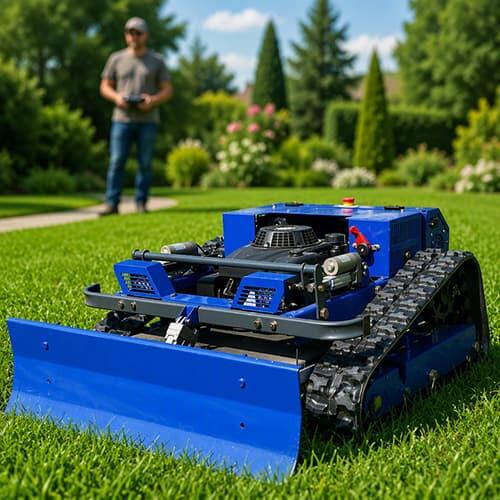
A slope is hard on components. These are the features that decide whether the machine comes back in one piece after its first season.
— Ground clearance that matches the ground. Skid plates are not enough. The chassis has to clear the same rocks and stumps the deck is expected to deal with, otherwise the frame becomes the cutting edge and the rest of the machine follows it into the dirt.
— A deck that floats and a linkage that cannot wedge. On a slope the ground is never flat. A rigid-mounted deck will ride up on one side and dig in on the other. Independent float with a generous arc, and a linkage that cannot bind against the chassis when packed with grass, make a noticeable difference when the cutting head follows uneven ground.
— Belts that run inside a cover, not through the grass. Open belts on a slope machine are consumables, not components. They pick up grit, cut themselves, and take the pulleys with them. Fully shrouded drives are non-negotiable in brushy or rocky work.
— A cooling path that stays open. Engines on slope machines run hot because the radiator sits where the grass throws itself at it. Mesh that is easy to lift and clean, or better still a reversible fan, pays for itself in one blocked-core summer. A machine that is easy to clean around the cooling system is much easier to keep working consistently.
— A deck and undercarriage you can clean without tools. If it takes ten minutes and a socket set, it will not get done. And the grass you did not clean is the grass holding water against the steel overnight.
These details are easy to overlook when comparing a tracked mower from a catalog. In actual commercial mowing, access for cleaning, inspection and routine service can affect machine availability just as much as the headline engine specification.
None of these will save your life. All of them will save your season, because a machine you dread operating is a machine you stop operating properly.
— A transmitter you can hold for eight hours. Weight, balance, and spring return on the drive levers. Test it in the shop for five minutes and you will learn nothing; carry it for a full shift and you will know whether the machine is usable.
— A sightline that does not require you to stand in the wrong place. You must be able to see the uphill side without standing above the machine. A tall mast or a swivelling operator position sounds minor until the third hour of a roadside job.
— A cutting width that fits the gate you actually use. It is astonishing how often this is missed. The machine that is perfect in the brochure and three inches too wide for the access gate is, in practical terms, unusable.
— Quiet enough to work near people. Electric has an obvious advantage here, but a well-silenced four-stroke is perfectly acceptable. What matters is whether the job can run at seven in the morning without a complaint, because that decides how many hours you actually get to bill.
For contractors and property-maintenance teams, these operating details are worth checking before purchase. A commercial mower is ultimately a working tool, so operator controls, visibility and site access need to match the actual work rather than only the machine's advertised capacity.
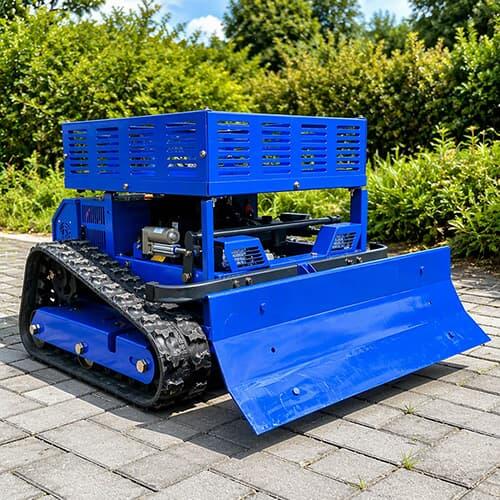
These are the features that do not make the machine safer or faster, but quietly decide whether you made the right purchase.
— Parts that exist in your country. A spare belt is a spare belt until you need it on a Friday and it has to come from another continent. Check the lead time on tracks, belts, and blades before you buy, not after.
— A dealer who will lend you a machine for a morning. Any seller confident in the product will let you put it on your worst slope for a few hours. The ones who will not are telling you something useful, and it costs you nothing to listen.
— Service points you can reach without dismantling the machine. Grease nipples buried behind the battery, a drain plug under a frame rail, a filter that needs three covers off — these are small insults that accumulate into a machine that does not get serviced.
— A price that leaves room for the second battery or the second set of tracks. The purchase price is rarely the whole story. The machine that costs ten percent more but ships with a spare pack and a set of wear bars is usually the cheaper one by Christmas.
Before placing an order, ask about replacement parts, service procedures, normal wear items and delivery times. These questions are particularly important when buying a remote control mower for commercial work, because downtime can cost more than the difference between two machines at the time of purchase.
What to do with the list is simple. Before you spend anything, take the three items in Tier 01 and ask to see them work, one by one. If any of them is absent or unconvincing, stop. The rest of the features are negotiations. The first five are not.
If you are comparing configurations for steep slopes, cutting widths or different track systems, you can contact our engineering team on WhatsApp for machine configuration information and operating details.
For additional product examples and field-operation videos, you can also visit our remote control mower product page.
The first priority is a predictable fail-safe and emergency stop system, followed by traction and machine stability. Horsepower should not be the first specification used to judge a slope machine.
Tracks can provide useful ground contact and positive engagement, but the actual suitability depends on the complete machine design, including centre of gravity, drivetrain, braking, track system and the manufacturer's operating limits.
A low-mounted engine and other heavy components keep more mass close to the chassis and reduce the height of the machine's centre of gravity. This can be more relevant to slope stability than simply increasing engine horsepower.
Uneven slopes can cause a rigid deck to contact the ground unevenly. A suitable floating deck allows the cutting head to follow changes in terrain more effectively and can reduce the tendency to dig into one side of the slope.
Start with wear items that can stop production: tracks, belts, blades or cutting components, filters and other model-specific service parts. Ask where they are stocked and what the normal supply lead time is for your country.
Do not only watch the cutting result. Ask to see the fail-safe response, emergency stop, traction behaviour, operator visibility, control response, deck movement and access to routine service points. These checks tell you much more about the machine's practical suitability.
Get instant pricing, specs, and shipping details from our team.