
86 13686388557

Date:2026-06-23
As the landscaping industry increasingly moves toward automation and intelligent equipment, remote control lawn mowers have become indispensable tools for contractors, municipal maintenance departments, orchard owners, and property management companies. Compared to traditional push mowers and ride-on mowers, modern remote-controlled tracked mowers offer superior safety and slope adaptability while significantly reducing labor requirements.
However, many users fail to fully leverage the productivity potential of their equipment. Industry observations reveal that a significant portion of operators utilize only about 60% to 70% of a machine's actual working capacity. This issue rarely stems from insufficient machine power. Instead, productivity losses often result from inefficient route planning, unnecessary task overlaps, inconsistent operating speeds, prolonged downtime, and a lack of preventive maintenance.
Professional landscaping companies understand that efficiency is not simply about driving faster. True efficiency means maximizing completed mowing area while minimizing downtime, fuel or battery consumption, operator intervention, maintenance costs, and rework. In commercial projects, implementing a structured workflow can increase daily output by 30%–40% while significantly lowering operating expenses.
Many contractors who regularly manage large-scale mowing projects often study real-world operating techniques through professional field demonstrations such as commercial mower operation videos and compare equipment performance from verified manufacturers before optimizing their own workflow systems.
One of the biggest misunderstandings of new operators is the belief that machine power determines productivity. In fact, the greatest loss in efficiency is usually caused by human decisions rather than mechanical limitations.
Efficient RC mowing = fewer stops + less overlap + zero unnecessary rework + longer continuous operating cycles.
The most productive operators focus on maintaining consistent machine movement, optimized mowing patterns, and uninterrupted workflow. Every unnecessary stop, sharp correction, repeated pass, or emergency restart directly reduces overall output.
Before starting any mowing project, professional crews conduct a detailed assessment of the worksite. This preparation stage is often overlooked but has the greatest impact on final productivity.
The first step is dividing the site into manageable working zones. Large properties should be separated into:
Flat open areas
Moderate slope sections
Steep hillside zones
Obstacle-dense areas
Edge finishing sections
By treating each zone independently, operators avoid constantly changing directions and operating methods. This systematic approach dramatically reduces wasted movement and improves machine utilization.
Obstacle removal is equally important. Stones, branches, vines, and hidden debris can cause blade impacts, track obstruction, or emergency stops. Clearing these hazards beforehand maintains uninterrupted operation and prevents costly downtime.
Another often-overlooked strategy is prioritizing difficult terrain first. Handle steep slopes, dense weeds, and heavy vegetation while batteries are fully charged or fuel tanks are completely filled. Easier areas can be completed later when machine power naturally declines.
Route planning is one of the simplest yet most powerful methods for increasing mowing efficiency.
Random driving patterns create excessive overlap and missed strips, forcing operators to perform secondary trimming. In many projects, inefficient routing can waste 15%–25% of total operating time.
For flat areas, use a parallel back-and-forth mowing pattern. Maintain consistent overlap between passes, typically around 3–5 cm. Excessive overlap reduces productivity, while insufficient overlap creates visible missed sections.
For slopes, always follow a contour mowing approach. Horizontal contour passes provide better stability and smoother operation while minimizing traction loss and unnecessary speed adjustments.
Professional operators also complete large open areas first before moving to boundaries and irregular edges. Concentrating edge work at the end prevents constant switching between different mowing modes.
Speed management directly influences mowing quality, productivity, and equipment wear.
Many inexperienced users assume maximum speed equals maximum efficiency. In reality, excessive speed often produces incomplete cuts, forcing additional passes that consume more time than operating correctly from the beginning.
Flat dry lawns: Medium-high constant speed
Moderate slopes: Balanced medium speed
Dense vegetation: Lower speed with higher torque
Wet or muddy terrain: Slow controlled operation
Steep slopes: Low-speed precision mode
The objective is maintaining smooth, uninterrupted movement rather than repeatedly accelerating and braking. Constant-speed operation reduces energy consumption and delivers more uniform cutting quality.
Blade condition has a direct impact on overall productivity.
Dull blades tear vegetation instead of cutting it cleanly. This increases resistance, creates deck blockages, and often requires additional finishing passes.
Keeping manganese steel cutting blades properly sharpened allows the machine to process thick grass and weeds more efficiently while maintaining cleaner results.
Cutting height should also be adjusted according to vegetation density. For overgrown sites, use a two-stage approach:
Higher initial cut to remove excess growth
Lower finishing cut for final appearance
This technique reduces machine load and prevents unnecessary power consumption.
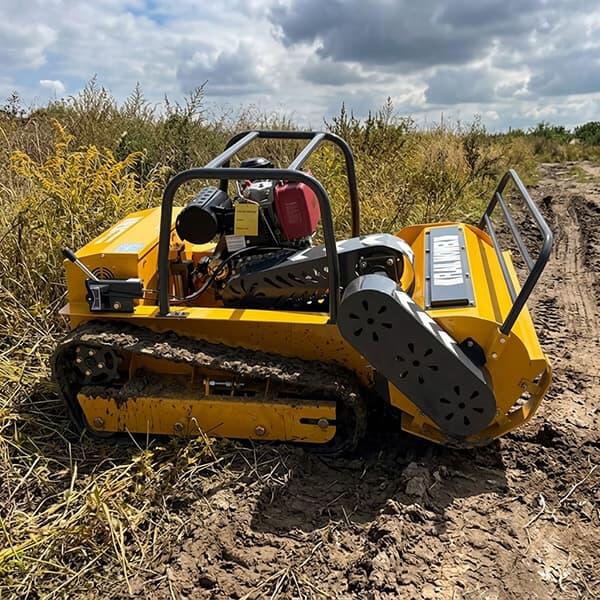
Many operators focus entirely on mowing speed while ignoring the hidden impact of downtime.
Short interruptions throughout the day often consume more working hours than actual mowing operations.
Examples include:
Repeated debris removal
Signal reconnection delays
Battery depletion
Fuel shortages
Unplanned maintenance
Route corrections
Professional contractors minimize these interruptions through proactive planning. Backup batteries, spare blades, fuel reserves, and scheduled maintenance checks ensure continuous operation.
Many commercial buyers sourcing equipment through international equipment suppliers prioritize machines designed for long-duration operation specifically because reduced downtime directly increases project profitability.
Efficiency is not only determined by today's operation. Long-term productivity depends heavily on equipment condition.
Simple daily maintenance tasks help preserve peak performance:
Remove mud and grass from tracks
Inspect blade sharpness
Check track tension
Verify remote control responsiveness
Inspect safety systems
Update software and firmware when available
A well-maintained machine consistently delivers higher output than a neglected unit, regardless of engine size or battery capacity.
| Operation Item | Casual Operation | Professional High-Efficiency Operation |
|---|---|---|
| Mowing Route | Random driving | Planned zoning and parallel passes |
| Speed Control | Frequent changes | Terrain-matched constant speed |
| Downtime | Frequent interruptions | Centralized maintenance schedule |
| Rework Rate | High | Minimal |
| Daily Productivity | 60%–70% | 95%+ utilization |
Q1: Why is my remote-controlled lawn mower slower than expected?
Great! Please message me and I will send you the detailed information.
Q2: Is maximum speed always the most efficient?
No. Excessive speed often causes missed grass and rework, reducing overall productivity.
Q3: How can I reduce overlap?
Use fixed-width parallel passes and maintain consistent visual reference points during operation.
Q4: Does maintenance really affect efficiency?
Absolutely. Sharp blades, clean tracks, and responsive controls significantly improve operating performance.
Q5: What is the fastest way to improve production efficiency?
Carry out area division, route planning, obstacle clearance and constant-speed operation.
To enhance the efficiency of using a remote-controlled lawn mower, the key lies not in exerting more force when operating the equipment, but in establishing a professional operation procedure that enables the machine to fully utilize its performance.
By ensuring proper site preparation, optimizing mowing routes, adjusting speeds for different terrains, minimizing downtime, and maintaining consistent upkeep, operators can significantly boost daily output while reducing operational costs. In today's highly competitive landscaping market, contractors often benefit from these efficiency gains, leading to sustained business growth.
If you're evaluating equipment upgrades or looking for recommendations for specific mowing projects, you can also contact professional product consultants directly via WhatsApp: +86 15244567951.
Get instant pricing, specs, and shipping details from our team.