
86 13686388557

Date:2026-07-21
remote control lawn mower are designed to make lawn maintenance safer, faster, and less labor-intensive. Whether you are maintaining residential lawns, orchards, solar farms, roadside slopes, or commercial landscaping projects, these mowers can significantly boost operational efficiency. However, occasional malfunctions are inevitable for any machine operating in demanding outdoor environments.
Fortunately, most of the malfunctions are not serious mechanical defects. They are usually caused by poor maintenance, incorrect operating habits, component wear, or environmental factors. Learning to identify the symptoms of faults early can help users avoid expensive repair costs, reduce downtime, and significantly extend the lifespan of the machine.
This troubleshooting guide explains the most common RC mower problems, their possible causes, and practical solutions that can quickly get your equipment back to work.
One of the most common issues is the inability to start, especially after long-term storage or during seasonal changes. In many cases, the lawn mower itself is not damaged, and the problem only lies in the power supply, consumption quality, or basic maintenance.
Possible Causes
Battery voltage is too low.
Old gasoline has deteriorated.
Dirty or worn spark plug.
Clogged air filter.
Emergency stop switch remains activated.
Recommended Solutions
Recharge or replace the battery before restarting.
Replace stale fuel with fresh gasoline if using a gasoline-powered model.
Inspect and replace the spark plug when necessary.
Clean the air filter to improve engine airflow.
Check that all safety switches have been reset correctly.
During long-term storage, starting the lawn mower every few weeks for a few minutes can help prevent fuel deterioration and battery discharge.
Signal interruption will halt the lawn mowing operation and reduce work efficiency. Most communication issues are related to the operating distance or interference, rather than controller failure.
Possible Causes
Low controller battery.
Wireless interference from nearby equipment.
Trees, buildings or metal objects blocking the signal.
Operating beyond the recommended control range.
Recommended Solutions
Replace or recharge the controller battery.
Maintain direct line-of-sight whenever possible.
Avoid operating close to powerful wireless transmitters.
Stay within the manufacturer's recommended operating distance.
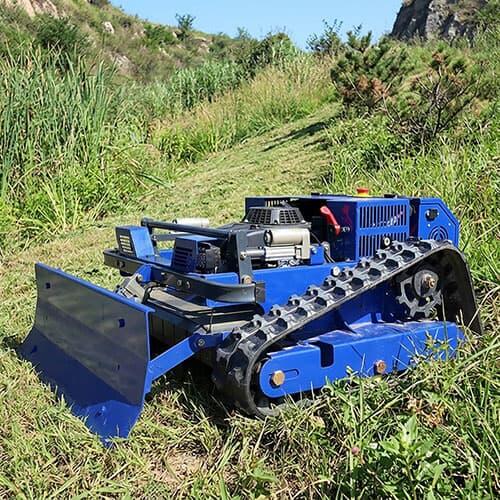
If there are uneven spots on the lawn after mowing, the problem usually lies with the cutting system rather than the engine. Uneven cutting can affect the appearance of the lawn and often requires multiple trims.
Possible Causes
Blades have become dull.
Cutting deck is not level.
Track or tire pressure is uneven.
Grass buildup underneath the deck.
Recommended Solutions
Sharpen or replace worn blades.
Adjust deck height evenly on both sides.
Check track tension or tire pressure.
Remove accumulated grass after every mowing session.
Dense vegetation and steep slopes place a heavy load on the engine or electric motor. If the machine slows down, stalls, or struggles to climb, it is usually due to an excessive workload.
Possible Causes
Grass is too tall or wet.
Blade resistance is too high.
Slope exceeds the recommended operating angle.
Continuous heavy-load operation causes overheating.
Recommended Solutions
Raise the cutting height for the first mowing pass.
Cut only dry grass whenever possible.
Reduce travel speed on steep slopes.
Allow the machine to cool during long commercial jobs.
For frequent hillside mowing, a tracked remote control mower provides significantly better traction and climbing performance than wheeled models.
Some vibration is completely normal when operating a remote control lawn mower. However, excessive shaking usually indicates that one or more components have become loose or damaged. Ignoring abnormal vibration can accelerate wear on bearings, blades, and the transmission system.
Possible Causes
Bent or unbalanced cutting blades.
Grass, mud, or stones stuck underneath the deck.
Loose mounting bolts.
Damaged blade shaft or bearing.
Recommended Solutions
Turn off the mower completely before inspection.
Remove all debris under the cutting deck.
Replace bent or cracked blades immediately.
Tighten all visible bolts and fasteners.
If vibration remains, inspect bearings or contact professional service.
Battery-powered RC lawn mowers normally provide stable working time, but runtime gradually decreases as batteries age. Heavy workloads and poor charging habits can also shorten operating time considerably.
Possible Causes
Battery has reached the end of its service life.
Continuous mowing of dense weeds.
Low-temperature operation.
Incorrect charging or storage habits.
Recommended Solutions
Replace batteries that are more than 2–4 years old.
Avoid completely discharging lithium batteries.
Store batteries indoors at moderate temperatures.
Reduce cutting load when mowing thick vegetation.
If the lawn mower accidentally turns, spins in place, or responds slowly to remote control commands, mechanical and electronic issues should be checked.
Possible Causes
Loose electrical wiring.
Track misalignment.
Damaged wheels or drive components.
Controller calibration error.
Recommended Solutions
Inspect visible wiring connections.
Adjust track tension according to the manual.
Remove wrapped grass or debris around moving parts.
Recalibrate the controller if supported by your model.
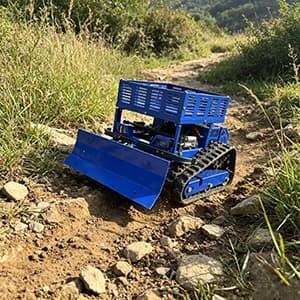
| Problem | Likely Cause | Recommended Fix |
|---|---|---|
| Won't Start | Battery, fuel, spark plug | Recharge, refill fuel, replace spark plug |
| Signal Loss | Weak controller battery or interference | Replace batteries and improve signal path |
| Uneven Cutting | Dull blades or uneven deck | Sharpen blades and level the deck |
| Power Loss | Heavy grass or steep terrain | Reduce load and mow in multiple passes |
| High Vibration | Loose or damaged blades | Inspect, tighten or replace components |
| Battery Drains Fast | Battery aging or overload | Replace battery and reduce workload |
The easiest way to avoid unexpected breakdowns is to follow a regular maintenance schedule. Spending just a few minutes after each mowing session can dramatically extend the service life of your remote control lawn mower, reduce repair costs, and maintain excellent cutting performance throughout the year.
✔ Clean the cutting deck, tracks, and wheels after every mowing session.
✔ Sharpen or replace mower blades every 20–30 working hours to maintain clean cutting performance.
✔ Check battery connectors and charging cables regularly for corrosion or loose connections.
✔ Inspect crawler tracks or tires for excessive wear and adjust track tension when necessary.
✔ Tighten all visible bolts, nuts, and blade mounting hardware during routine inspections.
✔ Lubricate moving components such as bearings, rollers, and pivot points according to the maintenance schedule.
✔ Store the mower in a dry, ventilated garage away from rain, direct sunlight, and freezing temperatures.
✔ For gasoline models, replace engine oil and clean the air filter according to the manufacturer's recommendations.
Pro Tip: Most of the unexpected malfunctions of lawn mowers are not due to manufacturing defects but are caused by improper maintenance. Conducting a simple check before and after each use can prevent costly repairs in the future.
Q: How often should the blades of a lawn mower be sharpened?
A: For ordinary household users, the blades should be sharpened every 20-25 hours of use, or at least once per mowing season. Commercial users may need to sharpen the blades more frequently depending on the working conditions.
Q: Can a remote-controlled lawn mower be used on rainy days?
A: Most professional models of mowers are equipped with waterproof electrical systems, but they should still be avoided in rainstorm. Wet grass can increase cutting resistance and may reduce traction, thereby reducing mowing efficiency and safety.
Q: What should I do if my lawn mower gets stuck?
A: Immediately stop the cutting blade, use the remote control to slowly reverse the vehicle, and check if there are any stones, branches or deep pits in the working area. Then continue the operation. Do not force-start the lawn mower while the blade is rotating.
Q: How long can lithium batteries usually last?
A: Most high-quality lithium batteries can provide a lifespan of 2-4 years or approximately 800-1200 charging cycles when stored and maintained correctly.
Q: Why does my lawn mower suddenly lose power while it is mowing the grass?
A: This situation usually occurs when cutting very thick grass, climbing steep slopes continuously, or using aged batteries. Cleaning the cutting surface and reducing the load of grass cutting can usually solve the problem.
Q: Where can I purchase replacement blades, tracks and spare parts?
A: It is essential to purchase genuine replacement parts from authorized suppliers to ensure compatibility, maintain safety standards, and maximize the lifespan of the machine.
Most remote control lawn mower problems are easy to diagnose when you understand the underlying causes. Issues such as starting failures, signal interruptions, uneven cutting, excessive vibration, battery drain, and poor traction are usually related to routine maintenance, operating habits, or worn components—not major equipment failures.
Adhering to the preventive maintenance schedule, promptly replacing worn parts, and operating the mower under recommended conditions will significantly improve reliability, reduce downtime, and extend the equipment's overall service life.
Whether you're choosing a new RC lawn mower, troubleshooting a technical issue, or looking for replacement parts, our team is ready to help.
💬 Get a Free Quote on WhatsAppFast Response • Professional Support • Worldwide Shipping
Get instant pricing, specs, and shipping details from our team.