
86 13686388557

Date:2026-07-17
Still unsure which of the tracked remote control mower or the wheeled RC mower is more cost-effective? Although both do not require manual pushing, which enhances the safety of mowing, their performance is quite different in slopes, rough terrains, wet grasslands and commercial operations. This guide will compare these two types of lawn mowers in detail to help you choose the right machine for your home or business.
The biggest difference between these two machines lies underneath the chassis. A wheeled remote control lawn mower moves using four drive wheels that touch the ground at several contact points. This lightweight structure delivers excellent maneuverability and fast travel speed on flat lawns.
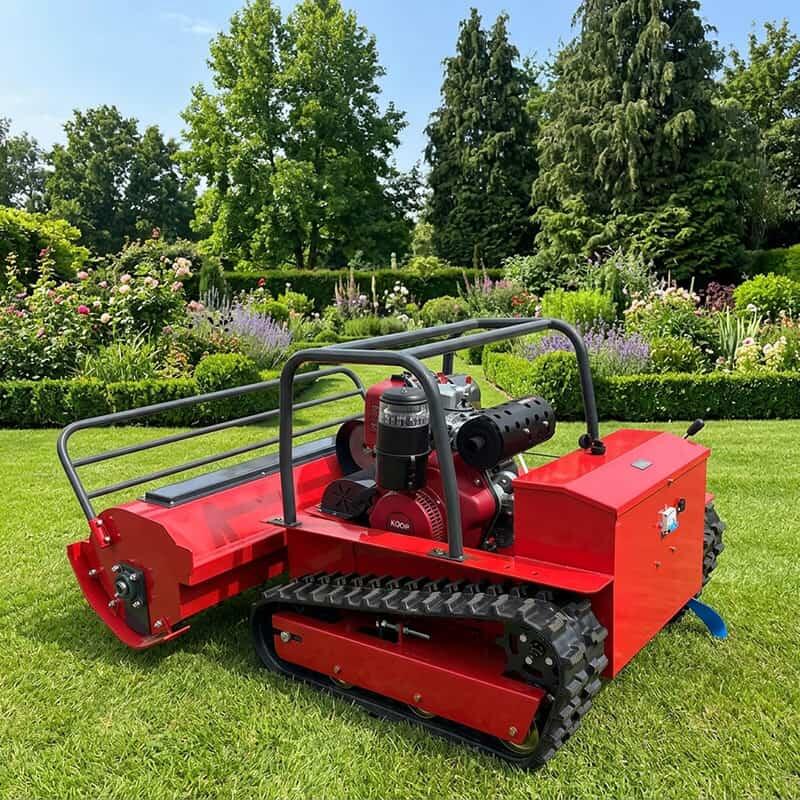
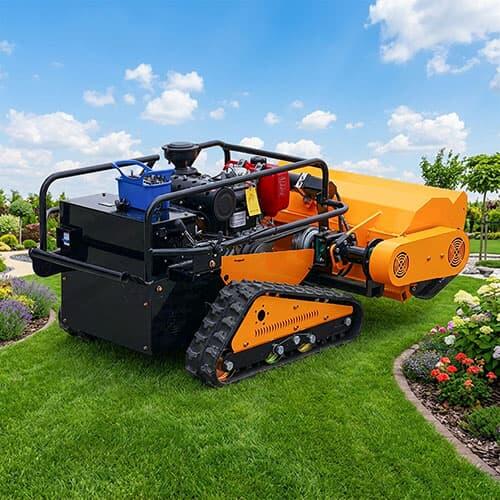
A tracked remote control mower, however, replaces traditional wheels with continuous rubber crawler tracks. Instead of concentrating weight onto four small points, tracks spread the machine's weight across a much larger surface area. This dramatically improves traction, stability, climbing ability, and control when working on difficult terrain.
Although both of these machines feature wireless remote control, significantly enhancing operator safety compared to traditional push-type lawn mowers, their distinct drive systems make them suitable for entirely different working environments.
Due to the extremely low rolling resistance produced by the wheels, wheeled remote-controlled lawn mowers are highly maneuverable when turning and can travel smoothly on open lawns. They can easily bypass flower beds, paths, garden ornaments and trees, making them highly suitable for residential landscapes with numerous obstacles.
The main reason why homeowners choose wheeled lawn mowers is their affordability. The simple structure of their transmission system means lower manufacturing costs, and the replacement of tires is inexpensive and readily available everywhere. Daily maintenance usually only requires clearing the grass clippings on the mower and checking the tire pressure.
On flat lawns, wheeled machines are far more efficient at rolling than tracked ones. This enables wheeled machines to rapidly cover large residential yards while consuming less energy when moving between mowing areas.
Most wheeled remote-controlled mowers are lighter than tracked models. Their smaller footprint minimizes soil compaction, helping to protect delicate lawns—particularly new ones or ornamental gardens that require careful maintenance.
Despite their advantages, wheeled machines have clear limitations once the terrain becomes challenging. On wet grass, loose gravel, muddy ground, or slopes above approximately 20 degrees, tire grip decreases rapidly. Wheel spin, sideways drifting, and reduced climbing performance become common problems.
They also struggle with deep ruts, uneven terrain, thick weeds, and heavy vegetation because limited ground contact reduces available traction. For commercial contractors maintaining difficult landscapes every day, these limitations often outweigh the lower purchase price.
Professional landscapers increasingly prefer tracked remote control lawn mowers because they deliver reliable performance in conditions where wheeled machines struggle. Their crawler-track design maximizes ground contact, distributes weight evenly, and produces outstanding traction across almost every type of terrain.
Whether maintaining highway embankments, vineyards, orchards, solar farms, drainage channels, or steep residential hillsides, tracked machines provide a level of stability that wheels simply cannot match.
💬 Need Help Choosing? Chat With Our Experts on WhatsApp
The biggest advantage of a tracked remote control mower is its ability to work safely on steep terrain. The crawler tracks provide a much larger contact area with the ground, allowing the machine to distribute its weight evenly and generate significantly more traction than tires. Commercial models can typically operate on 35°–45° slopes, making them ideal for hillsides, orchards, vineyards, riverbanks, and solar farms.
Wet grass, muddy soil, gravel paths, loose dirt, and uneven terrain often cause wheeled mowers to lose grip. Tracked machines continue moving steadily because the rubber crawler system maintains constant contact with the surface. This greatly reduces slipping, drifting, and loss of control while improving mowing consistency.
Commercial landscaping frequently involves cutting thick weeds, tall grass, brush, and neglected vegetation. Thanks to higher traction and stronger torque transmission, tracked RC mowers can maintain forward movement even when cutting dense material. This allows operators to finish difficult jobs faster while reducing the risk of blade stalling.
Because tracked mowers remain more stable on steep slopes, they greatly reduce rollover risks compared with traditional wheeled equipment. Combined with wireless remote operation, emergency stop functions, tilt protection, and automatic braking systems, they provide one of the safest mowing solutions available for professional landscaping.
The biggest drawback of tracked machines is their higher purchase price. Their reinforced chassis, crawler system, rollers, and tension mechanisms require more components and increase manufacturing costs.
Routine maintenance is also more involved. Operators should regularly inspect track tension, remove stones and debris from the track system, lubricate moving components, and replace worn tracks when necessary. Although maintenance is straightforward, it requires more attention than a standard wheeled mower.
On perfectly flat lawns, tracked models also turn slightly slower because crawler tracks create more friction than tires. While this difference is minor for commercial work, homeowners with small, perfectly level gardens may appreciate the extra agility of wheeled machines.
| Feature | Wheeled RC Mower | Tracked RC Mower |
|---|---|---|
| Slope Capability | Best below 20° | 35°–45° commercial slopes |
| Wet Grass Performance | Average | Excellent |
| Terrain Adaptability | Flat lawns | All-terrain operation |
| Heavy Grass Cutting | Moderate | Excellent |
| Maintenance | Simple | Moderate |
| Purchase Cost | Lower | Higher |
A wheeled remote control lawn mower is an excellent choice if your property consists mainly of flat lawns, decorative gardens, or residential landscapes where maneuverability and affordability are the highest priorities.
If you regularly maintain steep hillsides, orchards, vineyards, solar farms, municipal green spaces, or commercial landscaping projects, a tracked RC mower delivers far greater stability, safety, and productivity. Although the initial investment is higher, the long-term gains in efficiency and reduced labor costs usually make it the more economical solution.
📲 Get Professional Buying Advice on WhatsApp
Not necessarily. If your property is mainly flat, a Wheeled Remote Control Lawn Mower offers faster movement, easier steering, and lower maintenance costs. However, for steep slopes, muddy ground, vineyards, orchards, or commercial landscaping, a Tracked Remote Control Mower delivers significantly better traction, stability, and safety.
Yes, but only on gentle slopes. Most wheeled models perform best below 20°. On steeper hills, traction decreases quickly, especially after rain or on loose soil. For regular hillside maintenance, a Tracked RC Mower is the safer and more reliable choice.
Tracked machines do require regular inspection of the tracks, rollers, and tension system. However, with routine cleaning and proper maintenance, they offer excellent durability and much better performance on demanding terrain, making the additional maintenance worthwhile for professional users.
For small residential lawns, a wheeled model usually provides the best return on investment. For contractors, municipalities, farms, solar projects, and hillside properties, a Commercial Tracked Remote Control Mower reduces labor costs, improves productivity, and delivers a much higher long-term return despite the higher initial investment.
Choosing between a Tracked Remote Control Lawn Mower and a Wheeled RC Mower ultimately depends on where and how you plan to work. Wheeled models are ideal for homeowners with flat lawns who value speed, affordability, and easy maintenance. Tracked mowers, on the other hand, are specifically designed for steep slopes, rugged terrain, and wet environments, as well as for commercial applications requiring exceptional stability and safety.
Before purchasing, carefully evaluate the terrain, mowing frequency, vegetation density, and future maintenance requirements. Selecting the right machine from the start can improve mowing efficiency, reduce operating costs, extend equipment lifespan, and ensure a safer working experience.
Our experts can recommend the best Tracked or Wheeled Remote Control Lawn Mower based on your terrain, project size, and budget.
📲 Get a Free Quote on WhatsAppGet instant pricing, specs, and shipping details from our team.
Essential for the website to function. Cannot be disabled.
Help us understand how visitors interact with our website. Used for Google Analytics 4.
Enable enhanced functionality like live chat support.