86 13686388557

Date:2026-06-03
The lawn care and landscape maintenance industries in Europe and North America are undergoing one of the most significant transformations seen in decades. Driven by stricter environmental regulations, rising labor costs, rapid technological innovation, and evolving customer expectations, traditional landscaping equipment is gradually being replaced by a new generation of intelligent, low-emission, and labor-saving lawn care solutions.
For distributors, contractors, equipment importers and landscape business owners, understanding these changes is no longer an option. Companies that can align their equipment portfolios with the emerging market trends will have a greater chance of winning market share, improving profitability and enhancing customer loyalty. On the other hand, enterprises that continue to rely on outdated machinery are at risk of failing to meet the growing market expectations.
In recent years, many industry professionals have begun sourcing equipment directly from manufacturers through platforms such as Made-in-China supplier channels and global B2B marketplaces to gain access to the latest innovations in commercial mowing technology while reducing procurement costs.
One of the biggest misconceptions among buyers is the belief that the current market shift simply involves replacing old machines with new ones. In reality, Europe and North America are undergoing a fundamental transformation in the delivery of lawn maintenance services.
European markets increasingly prioritize zero-emission compliance, sustainability, and noise reduction, while North American buyers focus heavily on productivity, labor efficiency, and operational scalability. Despite these regional differences, both markets are moving toward the same destination: intelligent, remote-controlled, battery-powered equipment capable of delivering higher productivity with lower operating costs.
Perhaps the most visible trend across both regions is the rapid shift toward battery-powered lawn care equipment. Environmental policies throughout Europe continue to tighten emission standards for outdoor power equipment. Several municipalities have introduced restrictions on fuel-powered machinery in residential and public green spaces.
North America is also experiencing a similar trend. Commercial landscaping companies are increasingly recognizing that electric equipment offers significant long-term cost advantages. Expenses such as fuel, oil changes, exhaust system maintenance, and engine repairs can account for a substantial portion of annual operational budgets.
Modern lithium battery technology has eliminated many concerns that previously slowed adoption. Today's commercial battery systems provide longer runtime, faster charging, and stable power output suitable for demanding landscaping projects.
As a result, battery-powered remote control lawn mowers are becoming standard purchases for municipalities, contractors, and commercial landscape maintenance firms.
The landscaping labor shortage remains one of the most challenging issues facing contractors throughout Europe and North America. Finding experienced operators is increasingly difficult, while wage costs continue rising year after year.
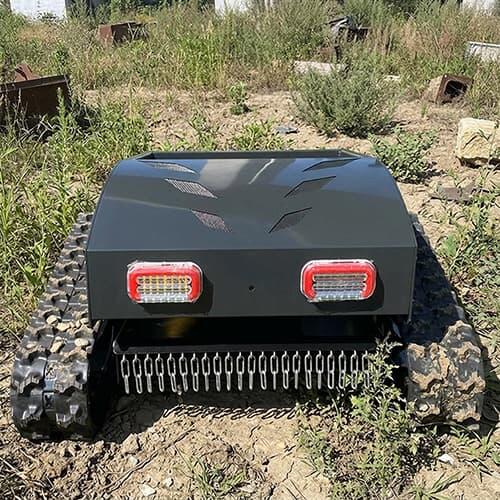
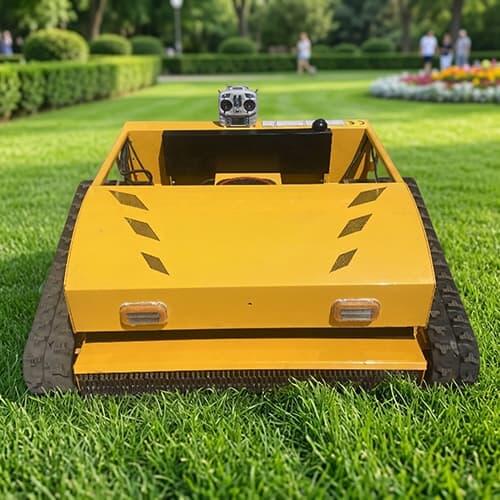
This challenge has accelerated the adoption of remote control crawler lawn mowers. Unlike traditional walk-behind or ride-on machines, RC mowers allow operators to maintain a safe distance while controlling equipment remotely.
The advantages extend far beyond convenience. Remote-controlled systems improve safety, reduce operator fatigue, and allow businesses to deploy labor more efficiently across multiple job sites.
Many contractors researching the latest commercial mower technologies regularly follow industry demonstrations through channels such as professional equipment field demonstrations, where real-world performance on slopes and difficult terrain can be observed before purchasing decisions are made.
Commercial landscaping projects increasingly involve complex terrain including:
Roadside embankments
Municipal green belts
Solar farm vegetation management
Hillside residential communities
Orchard maintenance
Mountain tourism facilities
These environments expose the limitations of conventional wheeled mowers. Buyers are therefore prioritizing equipment capable of handling steep slopes, uneven ground, wet soil, and dense vegetation.
Professional crawler-type remote control lawn mowers offer superior traction, lower rollover risk, and improved stability. Their ability to safely operate on challenging terrain opens access to higher-margin maintenance contracts that traditional equipment often cannot service efficiently.
European and North American commercial buyers increasingly evaluate equipment based on long-term durability rather than initial purchase price alone.
Machines equipped with:
Heavy-duty steel chassis
Sealed waterproof electrical systems
Industrial-grade crawler tracks
Wear-resistant cutting components
Corrosion-resistant coatings
are receiving stronger market demand because they provide predictable operating costs and longer service life.
Professional contractors understand that equipment downtime often costs more than the machine itself. Reliability has therefore become a major purchasing criterion.
Another major trend is the rapid growth of custom-branded landscaping equipment. Generic products face intense price competition, while branded equipment creates stronger customer recognition and improved profit margins.
Distributors increasingly request:
Custom logos
Exclusive color schemes
Private-label packaging
Localized user manuals
Market-specific feature configurations
This strategy allows sellers to differentiate themselves and build long-term brand equity instead of competing solely on price.
Many distributors initially explore product customization opportunities through international sourcing platforms such as Alibaba commercial equipment suppliers before establishing direct factory relationships.
Digital procurement has fundamentally changed how commercial buyers source lawn care equipment. Contractors and distributors now compare products, certifications, factory capabilities, and customer reviews online before making purchasing decisions.
This trend has increased transparency throughout the industry while creating greater opportunities for direct factory cooperation and customized production solutions.
Many buyers also prefer communicating directly with technical managers before placing large commercial orders to ensure equipment specifications align with local project requirements. Early technical consultation often helps reduce procurement risks and improve equipment selection accuracy.
| Trend Category | Europe | North America | Shared Direction |
|---|---|---|---|
| Primary Focus | Environmental compliance | Labor efficiency | Automation |
| Preferred Equipment | Battery-powered mowers | Commercial RC mowers | Terrain-adaptive equipment |
| Key Objective | Zero emissions | Higher productivity | Lower operating costs |
Environmental regulations, lower maintenance costs, reduced noise levels, and improved battery technology make electric equipment increasingly attractive for both commercial and residential users.
Commercial remote control crawler lawn mowers represent one of the fastest-growing segments due to their ability to improve safety, reduce labor requirements, and handle difficult terrain.
Europe places greater emphasis on environmental compliance, while North America focuses more heavily on productivity and labor efficiency. Both markets, however, are embracing intelligent automation.
Yes. Private-label products help distributors avoid direct price competition while building stronger customer loyalty and long-term brand value.
Electrification, intelligent automation, remote operation, full-terrain adaptability, and industrial durability will continue shaping purchasing decisions throughout the coming years.
The lawn care equipment industry in Europe and North America has entered a new era defined by electrification, automation, intelligent operation, and terrain adaptability. Businesses that embrace these trends will gain clear competitive advantages through improved efficiency, lower operating costs, and stronger market positioning.
As the requirements for commercial landscaping projects become increasingly stringent, and labor resources become increasingly scarce, intelligent equipment (such as remote control crawler lawn mowers) will shift from an optional upgrade configuration to an essential operational asset. For dealers, contractors, and equipment suppliers seeking long-term development, adapting to these market trends is no longer a future strategy but a necessary choice in the present.
Get instant pricing, specs, and shipping details from our team.