
86 13686388557

Date:2026-05-18
In 2026, selecting the right lawn mowing equipment has become one of the most critical decisions for commercial landscaping businesses. Rising labor costs, stricter safety standards, and growing demands for efficient property maintenance are compelling contractors to rethink traditional mowing methods.
In reality, no single machine is absolutely superior to another across all job sites. The optimal choice depends on terrain conditions, labor availability, project scale, and operational objectives. Understanding the strengths and limitations of both types of machines helps landscaping businesses make more informed, long-term decisions regarding equipment investment.
The reality is that neither machine is universally better for every job site. The best choice depends on terrain conditions, labor availability, project scale, and operational goals. Understanding the strengths and limitations of both options can help landscaping businesses make smarter long-term equipment investments.
One of the biggest challenges facing landscaping companies today is labor shortage. Skilled mower operators are becoming harder to recruit and retain, especially for physically demanding jobs involving steep slopes, rough terrain, and long working hours.
Remote control lawn mowers solve many of these operational problems by allowing operators to control machines from a safe distance while reducing physical fatigue and improving overall mowing efficiency.
Unlike traditional ride-on mowers, remote-controlled machines are especially effective in areas where safety risks are higher, including steep hillsides, drainage channels, roadside vegetation, solar farms, orchards, and uneven terrain.
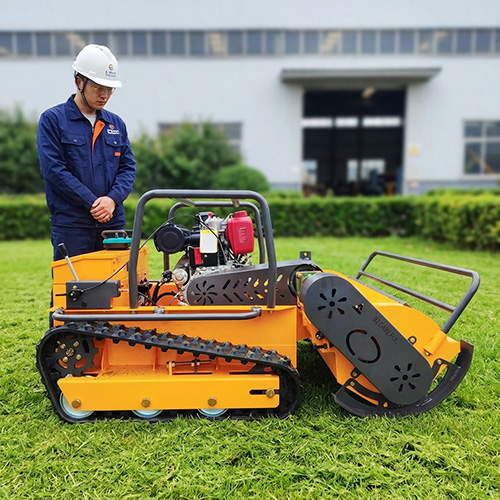
Ride-on mowers still remain highly effective for certain commercial applications. Large flat properties such as sports fields, airports, industrial parks, and wide open lawns often benefit from the speed and cutting width of commercial ride-on equipment.
For contractors handling mostly flat terrain with experienced operators, ride-on mowers may still offer strong productivity during continuous large-area mowing operations.
However, the limitations of ride-on equipment become more obvious when projects involve narrow access points, landscaping obstacles, steep slopes, or difficult terrain conditions that require greater maneuverability and safer operation.
| Comparison Factor | Remote Control Lawn Mower | Ride-On Mower |
|---|---|---|
| Terrain Adaptability | Excellent for slopes, rough terrain and narrow spaces | Best suited for large flat open areas |
| Safety | Operator stays at safe distance | Operator exposed to vibration and slope risks |
| Labor Efficiency | Reduces physical workload and improves flexibility | Requires dedicated operator at all times |
| Operating Cost | Lower maintenance and energy costs | Higher fuel and engine maintenance costs |
| Precision Around Obstacles | Better maneuverability in complex areas | Less effective near trees, curbs and flower beds |
| Long-Term ROI | Strong long-term savings for commercial use | Stable but higher operating expenses over time |
Safety regulations and liability concerns are becoming increasingly important in the landscaping industry. Accidents involving steep slopes, flying debris, or machine overturning can lead to serious injuries and expensive insurance claims.
Commercial-grade remote control lawn mowers help reduce these risks by allowing operators to work from a safe distance instead of sitting directly on the machine.
Modern remote mowers also include advanced safety systems such as emergency stop protection, obstacle sensing, anti-collision systems, and automatic blade shutdown functions that improve operational security in complex working environments.
While ride-on mowers often have lower initial purchase prices, long-term operating costs can become significant due to fuel consumption, engine maintenance, and operator fatigue.
Remote control lawn mowers usually require less routine maintenance because they contain fewer mechanical systems compared to traditional gasoline-powered ride-on machines.
For landscaping businesses handling diverse terrain conditions and facing labor shortages, the long-term return on investment from remote mowing equipment is becoming increasingly attractive.
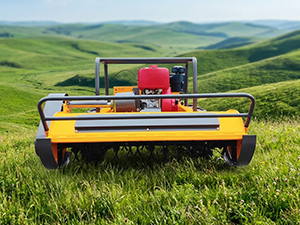
Many commercial buyers now prefer watching real operating demonstrations before investing in mowing equipment. Product specifications alone often do not fully reflect machine stability, traction capability, or cutting performance under difficult terrain conditions.
Through platforms like TikTok, overseas customers can watch our remote control lawn mowers operating on steep slopes, rough ground, and large commercial properties in real-world working environments.
These real field demonstrations provide a more realistic understanding of machine performance than edited marketing photos alone.
Equipment quality, spare parts availability, and technical support all directly impact long-term operational reliability for landscaping businesses.
Buyers can explore our commercial mowing equipment through our Alibaba store, where different machine configurations are available for commercial landscaping projects and international distributors.
For project consultation, machine recommendations, or wholesale cooperation, overseas clients often contact our manager Cara directly through WhatsApp (+86 15244567951) to discuss terrain requirements, mowing applications, and suitable equipment solutions.
We’ve compiled the most frequent questions we get from commercial landscaping contractors comparing these two mower types—no fluff, just straight answers.
mower entirely for my business?
Probably not—unless all your jobs are complex, sloped, or narrow. For most businesses, the best approach is to combine both: use ride-ons for large, flat areas and RCLMs for slopes, tight spaces, or when you need to reallocate crew to higher-value tasks (like pruning or client communication).
Q2: Are remote control lawn mowers harder to maintain than ride-ons?
No—they’re much easier. RCLMs have fewer moving parts (no engine, no transmission) so maintenance is limited to sharpening blades, checking batteries, and cleaning sensors. Ride-ons require regular oil changes, filter replacements, engine tune-ups, and tire maintenance—adding time and cost.
Q3: Do RCLMs work in all weather conditions? What about rain or extreme heat?
Commercial-grade RCLMs are built to withstand outdoor conditions—most have IPX5 waterproof ratings (resistant to rain and splashes) and high-temperature resistance (up to 40°C/104°F). However, like ride-ons, they should not be used in heavy downpours or extreme cold (below -5°C/23°F) to protect batteries and electronics.
Q4: Which option is better for commercial landscaping bids—having RCLMs or ride-ons?
RCLMs can give you a competitive edge. Many clients (especially HOAs and commercial property managers) prioritize safety, precision, and efficiency—mentioning RCLMs in your bid shows you’re using modern, reliable equipment. You can also bid on jobs with complex terrain that competitors with only ride-ons can’t handle.
Q5: How long do commercial-grade RCLMs and ride-ons last?
Both can last 5–7 years with proper maintenance. However, RCLMs may have a longer lifespan in harsh conditions because they have fewer moving parts prone to wear and tear. Ride-ons may need engine replacements after 3–4 years if used heavily.
Remote-controlled lawn mowers and ride-on lawn mowers still play a significant role in commercial landscaping. Choosing the right mower depends on the type of property you manage, terrain conditions, labor availability, and long-term operational goals.
For many modern landscaping companies, combining both equipment types often provides the best balance between speed, flexibility, safety, and operating efficiency.
As commercial landscaping continues to evolve toward smarter and safer operational methods, remote-controlled lawn mowers are becoming an increasingly valuable solution for businesses seeking greater efficiency and stronger long-term competitiveness.
Get instant pricing, specs, and shipping details from our team.