
86 13686388557

Date:2026-07-27
Steep slopes have long been among the most challenging areas to maintain. Whether managing vineyards, orchards, roadside embankments, solar farms, or large rural estates, dense grass and brush can quickly become unmanageable—or even pose safety risks. For decades, brushcutters have been the go-to solution due to their versatility and relatively low acquisition cost; however, their limitations become apparent as the terrain grows steeper.
Modern remote control lawn mowers tracked models—are transforming the way professionals handle slope maintenance. By eliminating the need for operators to work directly on hazardous terrain, these machines allow users to control operations safely from a distance while maintaining excellent cutting performance on complex landscapes.
But does this mean that remote-controlled mowers can completely replace brushcutters? The answer depends on terrain, vegetation density, frequency of use, and long-term operating costs. In this guide, we compare the two types of machines based on key factors—such as safety, productivity, cutting performance, labor requirements, and total cost of ownership—to help you determine which solution is best suited for your site.
In confined areas, brush cutters remain effective tools for trimming weeds, dense grass, and sparse scrub. They are lightweight and portable, capable of reaching places inaccessible to large machinery. However, these advantages quickly diminish once the operator encounters steep or rugged terrain.
Unlike machines capable of supporting their own weight, brush cutters rely entirely on the operator. When moving uphill, every step requires the operator to balance their center of gravity and manage engine vibration while simultaneously controlling the high-speed rotating blade. As the slope steepens, maintaining stability and cutting precision becomes increasingly difficult.
Higher risk of slips, falls, and operator injury on steep ground.
Rapid physical fatigue that reduces both productivity and work quality.
Difficulty maintaining an even cutting height across uneven terrain.
Industry professionals often report that mowing on slopes takes longer than working on flat ground, as every step requires extra effort and heightened caution. Even experienced operators must constantly adjust their stance while bearing the full weight of the machine, making large-scale slope maintenance projects both physically demanding and time-consuming.
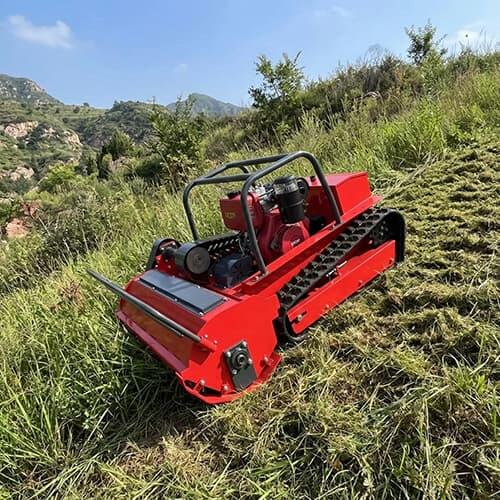
Rather than asking the operator to work on dangerous terrain, a tracked remote control mower moves the person away from the hazard entirely. The operator remains on stable ground while guiding the machine remotely, dramatically improving both safety and comfort during long working sessions.
Its greatest advantage lies in the tracked drive system. Compared to traditional wheels, tracks distribute weight over a larger contact area, generating superior traction and enhancing stability on soft soil, wet grass, gravel paths, and uneven slopes. Combined with a low center of gravity, this professional remote-controlled mower can confidently operate on slopes where manual mowing would be unsafe.
Modern commercial models offer cutting performance comparable to dedicated brushcutters. Equipped with powerful gasoline engines or high-torque electric drive systems, they efficiently handle thick grass, weeds, dense vegetation, and light brush, while maintaining a more consistent cutting height across the entire slope.
Remote operation keeps operators away from dangerous slopes.
Excellent traction on wet grass, loose soil, and rugged terrain.
Consistent cutting performance across uneven landscapes.
Reduced operator fatigue during long working hours.
Higher productivity for commercial property maintenance.
While both machines are capable of clearing vegetation, they are designed with different priorities in mind. Brush cutters emphasize portability and flexibility, whereas tracked remote control lawn mowers focus on operator safety, higher productivity, and continuous performance on demanding terrain.
The following comparison highlights key practical differences that users should consider when selecting equipment for mowing on slopes. Beyond the purchase price, it is crucial to evaluate long-term operational efficiency, labor costs, and overall safety.
| Comparison Item | Brush Cutter | Tracked RC Mower |
|---|---|---|
| Operator Safety | Low on steep slopes | Remote operation keeps users at a safe distance |
| Labor Intensity | High physical effort required | Minimal physical workload |
| Working Efficiency | Suitable for small areas | Ideal for medium and large properties |
| Slope Performance | Depends on operator ability | Stable climbing on steep hills |
| Cutting Consistency | Operator dependent | Uniform cutting across the entire area |
| Long-Term Productivity | Limited by operator fatigue | Consistent performance throughout the day |
The answer isn't simply that one machine is better than the other. Instead, the right choice depends largely on the type of property being maintained and how frequently mowing is required.
You only maintain a relatively small area.
The terrain contains tight spaces that larger equipment cannot access.
Vegetation control is occasional rather than frequent.
Your primary concern is minimizing initial equipment cost.
You regularly mow steep hills or uneven terrain.
Safety is a top priority.
You maintain vineyards, orchards, solar farms, highways, or municipal green areas.
You want higher productivity while reducing labor costs.
You perform commercial landscaping on a regular basis.
For professional users, the investment in a tracked RC mower is often recovered through improved efficiency, lower labor intensity, and reduced workplace safety risks. Although the initial purchase price is higher, the long-term operating advantages become increasingly apparent as working hours accumulate.
Purchase price is often the first thing buyers notice, but it should never be the only factor when comparing a brush cutter with a remote control lawn mower. Daily operating expenses, labor requirements, maintenance frequency, and overall productivity have a much greater impact on the total cost of ownership over several years.
Brush cutters typically require a lower initial investment, making them attractive to homeowners who use them only occasionally. However, since the work relies entirely on manual labor, mowing large lawns or steep terrain can quickly become time-consuming and physically demanding. As labor costs continue to rise, the total operating cost increases accordingly.
Although tracked remote-controlled mowers require a higher initial investment, they significantly reduce manual labor while boosting daily productivity. For landscaping companies, municipal departments, farms, and commercial property owners, the time saved can often offset the higher purchase cost within a relatively short period.
When evaluating equipment, the total cost of ownership should be compared, including labor, maintenance, fuel or electricity, downtime, productivity, and expected service life. Purchasing the machine with the lowest price tag is not always the most economical solution in the long run.
| Cost Factor | Brush Cutter | Tracked RC Mower |
|---|---|---|
| Initial Investment | Lower | Higher |
| Labor Cost | High | Low |
| Maintenance | Simple | Routine professional maintenance |
| Working Efficiency | Moderate | High |
| Long-Term Value | Suitable for occasional work | Excellent for frequent commercial use |
Q: Can remote-controlled mowers completely replace brush cutters?
A: For most applications involving hillside mowing, orchards, vineyards, solar farms, and commercial landscaping, tracked remote-controlled mowers can replace brush cutters while offering higher efficiency and superior operational safety. However, brush cutters remain highly useful in extremely tight spaces or areas inaccessible to large equipment.
Q: Which type of machine is better suited for operating on steep slopes?
A: Tracked remote-controlled mowers are much safer because the operator can control the machine from a distance instead of standing directly on the slope. This significantly reduces the risk of slips, falls, and blade injuries.
Q: Are remote-controlled tracked lawn mowers suitable for commercial landscaping?
A: Yes. Professional tracked mowers are designed for demanding environments—such as roadside embankments, orchards, vineyards, parks, solar farms, and other large-scale commercial maintenance projects—where productivity and safety are paramount.
Q: Does a remote-controlled mower require more maintenance than a brush cutter?
A: Remote-controlled mowers do require regular inspection of components such as tracks, blades, batteries, or engines, but routine maintenance helps ensure reliable performance and extends their service life. For commercial users, the additional maintenance costs are typically offset by significant gains in efficiency.
Q: Which approach offers greater long-term value?
A: If mowing is only occasional and the work area is small, a brush cutter might suffice. However, for the regular maintenance of slopes or professional landscaping, a tracked remote-controlled mower typically offers greater long-term value by reducing labor costs, increasing productivity, and enhancing safety.
Brush cutters and crawler lawn mower each have their own advantages, but they serve different purposes. Brush cutters remain suitable for light trimming and areas with limited space, whereas remote-controlled mowers are designed to enhance safety, efficiency, and productivity on larger, more complex terrain.
For owners of steep slopes, orchards, vineyards, highway embankments, or commercial landscapes, investing in a professional remote-controlled tracked mower can significantly reduce manual labor while delivering faster, safer, and more consistent mowing results.
Selecting the right equipment ultimately depends on your terrain, workload, and long-term maintenance goals. Beyond the purchase price, evaluating other factors is essential to choosing a solution that delivers reliable performance and offers greater value for years to come.
Get instant pricing, specs, and shipping details from our team.
Essential for the website to function. Cannot be disabled.
Help us understand how visitors interact with our website. Used for Google Analytics 4.
Enable enhanced functionality like live chat support.