
86 13686388557

Date:2026-06-17
One of the most common questions buyers ask before investing in a remote control lawn mower is simple: how steep of a slope can it safely handle?Whether you are a landscaping contractor, orchard owner, municipal maintenance team, or property management company, slope performance often determines whether a mower can complete a project efficiently and safely.
Unfortunately, many buyers are misled by the marketing parameters. Some manufacturers claim that their slope ratings are 45°, 50° or even higher, but these data are usually measured under ideal testing conditions. However, the actual application environment includes wet grasslands, soft soil, uneven terrain, rocks, dense weeds and variable weather. In practical applications, the available slopes are usually lower than the values measured in the laboratory.
After years of serving global customers and collecting real-world feedback through our manufacturing channels and overseas partners, we've found that understanding real working slope capacity is far more important than focusing only on advertised numbers.
The biggest misconception in the industry is the belief that a lawn mower with a rated slope of 45° can operate safely on a 45° incline every day.
In practice, manufacturers typically test maximum slope working capability on dry, firm, unobstructed ground with minimal cutting resistance. Once factors such as moisture, weeds, uneven ground, or driving on side slopes are introduced, the actual working angle will be significantly reduced.
Most professional contractors use a simple rule:reserve a safety margin of 15%–30% below the advertised slope rating to ensure long-term stability and operator safety.
These models are primarily designed for homeowners maintaining residential lawns with mild inclines.
Advertised slope: 25°–30°
Real working slope: 20°–28°
Best for: gardens, residential lawns, small properties
Although affordable, these machines typically use lighter chassis structures and narrower tracks, limiting their performance on challenging terrain.
For orchard operators, estate owners, and small landscaping companies, mid-range crawler mowers provide an excellent balance between price and performance.
Advertised slope: around 40°
Real working slope: 35°–38°
Best for: orchards, farms, private slopes, green belts
These models feature widened tracks, improved traction systems, and lower center-of-gravity chassis designs that greatly enhance stability.
Professional contractors handling highway embankments, solar farms, municipal projects, and mountain slopes typically rely on commercial-grade crawler mowers.
Advertised slope: 45°–50°
Real working slope: 40°–45°
Best for: steep commercial terrain and high-risk projects
These units incorporate reinforced crawler systems, intelligent torque management, industrial-grade frames, and advanced safety controls.
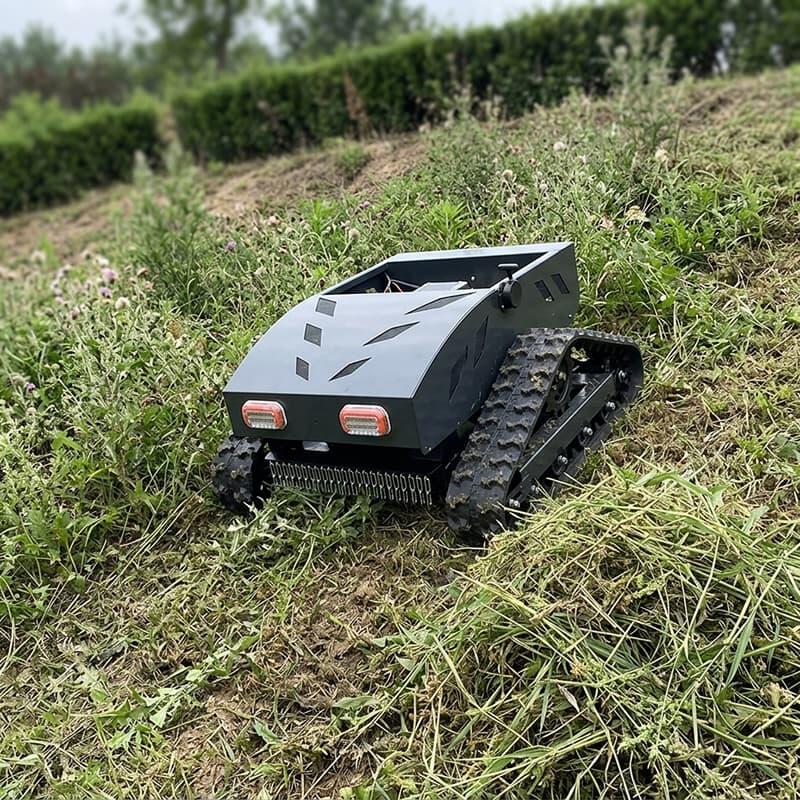
Buyers often focus on engine size or motor power, but actual slope performance depends on several key engineering factors.
A properly balanced chassis dramatically improves hillside stability. Commercial-grade machines place heavy components lower in the frame to reduce rollover risk and improve traction.
Wider crawler tracks distribute machine weight more evenly and create stronger ground contact. This improves grip on wet grass, gravel, and soft soil while reducing sinking and side-slip.
Steep slopes demand consistent power output. Machines equipped with industrial-grade drive systems maintain stable movement even when climbing while cutting dense vegetation.
Professional RC mowers should include:
Signal-loss automatic stop
Emergency stop controls
Slope protection systems
Anti-rollover design
These features become especially important when working near roadsides, steep embankments, and public infrastructure.
Over the past few years, demand for commercial remote control crawler mowers has increased rapidly across Europe and North America.
Contractors are no longer satisfied with equipment that can only operate on flat lawns. Highway maintenance, solar farm vegetation management, railway embankments, and orchard slope mowing all require machines capable of handling challenging terrain safely.
Many contractors who discover our products through our Made-in-China showroomor ourAlibaba International Storeoften report that slope capability and safety improvements are among the primary reasons they upgrade from traditional mowers.
Real operation videos shared through ourTikTok demonstration channelalso help buyers compare laboratory specifications with actual field performance.
Even the best mower should be operated within safe limits.
Dry slopes: up to 100% of rated working capacity
Mixed terrain: reserve 5° safety margin
Wet conditions: reserve 10° safety margin
Side-slope mowing: reduce operating angle by 5°–8°
Professional operators understand that maximizing productivity is not about pushing equipment to its absolute limit every day. Consistent, safe operation results in lower maintenance costs and longer machine life.
| Mower Type | Rated Slope | Real Working Slope | Typical Application |
|---|---|---|---|
| Residential RC Mower | 25°–30° | 20°–28° | Home lawns |
| Mid-Range Crawler Mower | 40° | 35°–38° | Orchards & estates |
| Commercial RC Mower | 45°–50° | 40°–45° | Highway & municipal projects |
Not necessarily. Terrain conditions, moisture, vegetation density, and operating direction all influence real-world performance.
Yes. High-quality crawler systems significantly improve traction, stability, and safety compared with traditional wheel-based machines.
Most professional contractors operate within the 30°–40° range, making commercial crawler mowers the preferred solution.
Evaluate your actual working conditions rather than relying only on maximum advertised slope ratings.
The maximum slope a remote control lawn mower can handle depends on much more than a number printed on a specification sheet. Chassis design, crawler quality, power delivery, safety systems, terrain conditions, and operating practices all contribute to real-world performance.
For most residential and agricultural applications, machines that can maintain a stable working angle of 35°–38° are already sufficient. However, for professional contractors dealing with road slopes, solar power plants, and mountain vegetation management, commercial crawler-type lawn mowers with a mature working angle of 40°–45° can achieve the best balance between productivity, safety, and long-term investment returns.
For product recommendations, project matching, or technical consultation, you can also contact our sales manager Cara directly via WhatsApp:+86 15244567951.
Get instant pricing, specs, and shipping details from our team.