
86 13686388557

Date:2026-06-19
Cutting grass on steep slopes has always been one of the most challenging tasks in modern landscaping maintenance. Traditional push-type lawn mowers and riding lawn mowers often struggle to operate on slopes due to risks of tipping over, operator fatigue, and unstable cutting quality. Therefore, Remote Control Lawn Mowers have rapidly become the preferred solution for contractors, municipal departments, orchard owners, and property maintenance teams when dealing with complex terrains.
However, purchasing a professional Crawler Lawn Mower is only part of the solution. Many users focus solely on the machine's specifications and overlook proper operation methods. Even the most advanced equipment can experience issues such as slipping, instability, or reduced mowing quality if used improperly on steep terrain.
Through years of field experience and customer feedback from commercial projects worldwide, we have found that successful Steep Slope Mowing depends on three key factors: machine capability, operator technique, and terrain assessment. This guide explains how professionals safely and efficiently operate remote control mowers on steep slopes while maximizing productivity and protecting equipment longevity.
Many international customers first review real-world slope mowing demonstrations through our TikTok field demonstration channel, where various hillside and embankment projects showcase practical operating methods in actual working conditions.
One common misconception is that if a mower is rated for a 40° slope, it can safely work on every 40° hillside. In reality, rated slope capacity and actual working slope are often very different.
Manufacturers typically test maximum slope angles under ideal conditions: dry grass, firm soil, perfect grip, and no cutting resistance. Real-world environments, however, include damp grass, uneven ground, exposed rocks, dense weeds, and hidden potholes. These factors significantly impact stability and safety.
Professional operators therefore prioritize controlled operation rather than simply pushing equipment to its maximum advertised limits.
Experienced contractors understand that proper preparation determines most of the project's success. Before entering any slope maintenance site, conduct a full inspection.
Measure or estimate the actual slope angle. Most commercial-grade Remote Control Mowers can safely operate between 35° and 40°, while some heavy-duty crawler models may reach 45° under favorable conditions.
Check for:
Loose soil
Wet grass
Exposed rocks
Tree roots
Drainage channels
Hidden depressions
These obstacles can reduce traction and create instability during operation.
Before mowing, inspect the area first. Remove loose branches, large stones, waste materials and any debris that may hinder the rotation of the blade or the movement of the tracks.
Professional landscaping teams usually spend a few minutes inspecting slopes before mowing, as this small investment can often avoid expensive maintenance costs and unnecessary downtime.
Verify:
Track tension
Blade sharpness
Battery charge or fuel level
Remote control responsiveness
Emergency stop functionality
Signal stability
For commercial users seeking detailed machine specifications and operating recommendations, many review available configurations through ourofficial Made-in-China showroombefore selecting equipment for hillside maintenance projects.
Successful Slope Maintenance requires a structured workflow. Random movement patterns often produce uneven cutting and increase accident risks.
Always stand on stable ground outside the dangerous slope zone. Avoid standing directly on loose or steep terrain.
The operator should maintain a clear line of sight to the machine at all times while avoiding signal-blocking obstacles such as dense trees, retaining walls, or structures.
Activate the mower and allow systems to stabilize before beginning work.
Low-speed operation provides smoother torque delivery and significantly reduces the risk of sudden traction loss on inclines.
This is arguably the most important professional technique.
Whenever possible, mow horizontally across the slope rather than repeatedly driving straight up and down.
Cross-slope movement distributes weight more evenly and minimizes rapid downhill acceleration if traction decreases unexpectedly.
Maintain overlap between passes to ensure complete coverage and a consistent finish.
For slopes under 30°, moderate speed generally provides the best balance between productivity and control.
For slopes above 30°, use low-speed settings and avoid aggressive acceleration, sharp steering, or sudden braking.
Consistency is more important than speed when operating on steep terrain.
Maintain a safety buffer near retaining walls, drainage ditches, embankment edges, and drop-offs.
A clearance distance of approximately 30–50 cm helps reduce the likelihood of side-slip incidents.
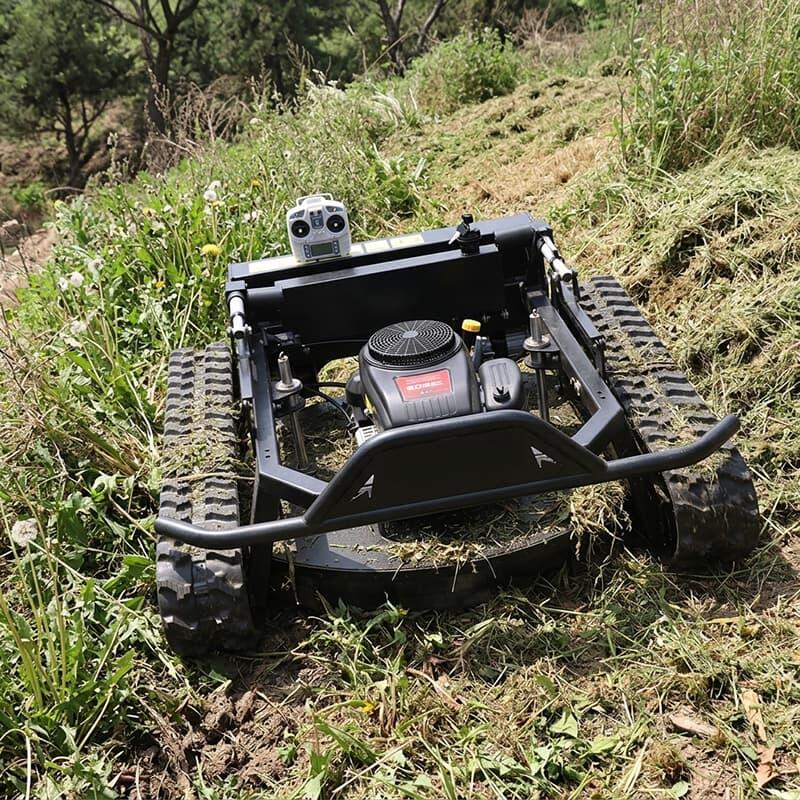
Moisture dramatically reduces traction. Professional crews often reduce operating speed and increase overlap between mowing passes when working on wet grass.
If soil becomes excessively muddy, postponing work may be more efficient than risking equipment sinking or track clogging.
Allow the crawler system to naturally adapt to uneven surfaces. Avoid forcing the mower over obstacles at high speed.
Slow and controlled operation preserves blade life and reduces chassis stress.
When approaching maximum operating angles, prioritize stability over productivity.
Reduce directional changes, avoid unnecessary maneuvers, and focus on maintaining a predictable mowing pattern.
Driving aggressively on steep inclines
Operating beyond recommended slope limits
Ignoring unstable weather conditions
Working with worn tracks
Using dull blades
Continuing operation when signal quality becomes unstable
Mowing immediately after heavy rainfall
These mistakes are responsible for a large percentage of avoidable equipment damage and operational incidents.
One observation consistently shared by experienced landscaping contractors is that equipment capability alone does not guarantee successful hillside maintenance.
The most productive crews combine high-quality Commercial Lawn Mowers with disciplined operating procedures. Proper route planning, hazard assessment, and speed management often increase productivity more than upgrading to a larger machine.
For distributors, contractors, and project managers evaluating equipment for large-scale slope maintenance, customized recommendations and project-specific guidance are available directly from our product manager Cara viaWhatsApp. Discussing actual terrain conditions before purchase often helps buyers select the most suitable configuration while avoiding unnecessary investment.
| Mower Type | Rated Max Slope | Practical Working Slope | Best Application |
|---|---|---|---|
| Entry-Level RC Mower | 30° | 25°–28° | Residential Lawns |
| Mid-Range Crawler Mower | 40° | 35°–38° | Orchards & Small Commercial Sites |
| Commercial Heavy-Duty Mower | 45°–50° | 40°–45° | Highway Slopes & Municipal Projects |
Yes. Horizontal operation distributes weight more evenly and reduces rollover risks on medium and steep slopes.
Yes, provided terrain conditions are suitable and operators follow proper speed and safety procedures.
Wet soil and grass significantly reduce friction, which lowers effective slope performance and stability.
Maintain consistent overlap between passes and perform visual inspections after completion.
No. Commercial tracked lawn mowers are designed specifically for complex terrains. Proper operation and maintenance can prevent premature wear and tear.
Steep Slope Mowing is far more than just driving a lawn mower uphill. It requires thorough preparation, route planning, speed control, terrain perception, and strict safety awareness. By following professional operating procedures, users can significantly improve the quality of lawn mowing, reduce equipment wear and tear, and eliminate unnecessary safety hazards.
For contractors, municipalities, orchards, and property managers, mastering these techniques transforms a Remote Control Lawn Mower from a simple machine into a highly productive asset capable of delivering consistent results on some of the most challenging landscapes.
Get instant pricing, specs, and shipping details from our team.