86 13686388557

Date:2026-06-05
The lawn care and landscape maintenance industries across Europe and North America are experiencing one of the most significant transformations in recent decades. Driven by stricter environmental regulations, rising labor costs, rapid technological innovation, and changing customer expectations, traditional landscaping equipment is gradually being replaced by more efficient, intelligent, and sustainable alternatives.
For distributors, contractors, municipalities, and landscaping business owners, understanding these market shifts is no longer optional. Companies that adapt early are gaining competitive advantages, while those relying on outdated equipment are finding it increasingly difficult to meet modern project requirements. The market is moving toward battery-powered equipment, remote control lawn mowers, intelligent automation, and equipment capable of handling increasingly complex terrain conditions.
Many professional buyers researching these developments regularly follow industry updates through manufacturers and suppliers active on platforms such as Alibaba InternationalandMade-in-China, where the newest commercial landscaping technologies are often introduced first.
Many people assume the current market trend is simply about replacing older machines with newer models. In reality, Europe and North America are undergoing a complete transformation in how landscaping services are delivered.
European markets increasingly emphasize zero-emission compliance, environmental sustainability, and low-noise operation. North American contractors, meanwhile, focus heavily on labor reduction, productivity improvement, and equipment capable of covering larger service areas efficiently.
Despite these regional differences, both markets are converging toward the same destination: electrification, automation, intelligent operation, and all-terrain adaptability.
One of the strongest trends shaping the lawn care industry is the rapid shift from gasoline-powered machines to battery-powered alternatives. Governments throughout Europe continue introducing stricter environmental policies that limit emissions from outdoor power equipment. Similar regulatory pressure is also increasing across many regions of North America.
As battery technology improves, commercial users are discovering that modern electric systems can now deliver performance levels that were previously achievable only with fuel-powered equipment. Today's high-capacity lithium battery platforms provide longer operating times, faster charging cycles, and significantly lower operating costs.
For contractors, the advantages extend beyond environmental compliance. Battery-powered machines eliminate fuel expenses, reduce routine maintenance requirements, minimize noise complaints, and create a cleaner working environment for operators and nearby communities.
The increasing popularity of remote control lawn mowers is perhaps the most noticeable development in commercial landscaping.
Labor shortages remain a major challenge throughout Europe and North America. Finding experienced operators has become increasingly difficult, while wages and insurance costs continue rising. As a result, landscaping companies are actively searching for equipment that allows smaller teams to complete larger projects.
Modern RC crawler lawn mowers solve this challenge by allowing operators to work from safe locations while controlling machines remotely. One operator can often supervise multiple work zones more efficiently than traditional mowing methods allow.
This technology has become especially valuable for maintaining:
Highway embankments
Roadside vegetation
Solar farm green belts
Mountain slopes
Orchards and vineyards
Large municipal green spaces
Many landscaping professionals first encounter these technologies through demonstration videos shared on industry channels such asMower102andAgricultural Machinery, where real-world terrain performance can be observed in actual operating environments.
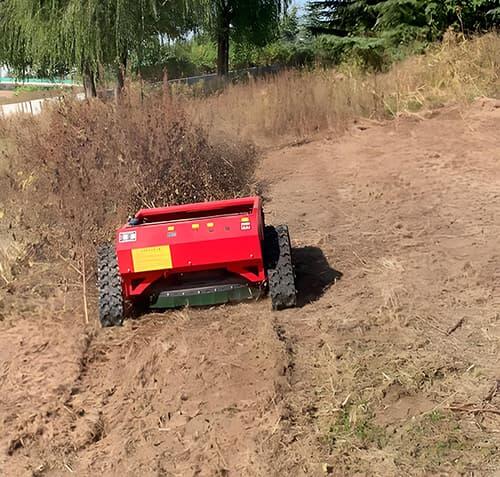
Traditional wheeled mowers perform adequately on flat residential lawns, but commercial projects increasingly involve terrain that is far more demanding.
Throughout Europe and North America, landscaping companies frequently maintain:
Steep hillsides
Roadside slopes
Railway embankments
Solar installations
Mountain parks
Agricultural terraces
These environments require equipment specifically engineered for stability, traction, and operator safety. This is why crawler-based remote control mowers have experienced rapid growth across professional markets.
Rather than focusing solely on engine power, buyers are prioritizing equipment capable of maintaining stability and productivity in challenging conditions. Terrain adaptability is increasingly viewed as a critical purchasing factor rather than a premium feature.
Professional buyers in Europe and North America typically evaluate equipment based on total ownership cost rather than initial purchase price alone.
Machines designed with reinforced steel frames, sealed electrical systems, waterproof components, and wear-resistant construction are receiving greater attention because they reduce long-term operating expenses.
Contractors increasingly recognize that downtime, repair costs, and equipment replacement expenses have a far greater impact on profitability than the initial purchase price.
As a result, industrial-grade construction quality is becoming a major competitive advantage across the lawn care equipment industry.
As product performance becomes increasingly standardized across the industry, distributors are searching for new ways to differentiate themselves.
Private-label and custom-branded landscaping equipment are becoming increasingly popular throughout North America, Europe, and Australia. Customized branding allows distributors to build stronger customer loyalty, improve brand recognition, and avoid competing solely on price.
Services such as logo customization, color matching, multilingual interfaces, and branded packaging are creating new opportunities for distributors seeking long-term market growth.
Online sourcing has become the preferred purchasing method for many commercial buyers. Rather than attending multiple trade shows or relying exclusively on local distributors, procurement managers now compare products globally through digital platforms.
This trend is creating greater transparency and giving buyers direct access to manufacturers, technical support teams, and factory-direct pricing structures.
For buyers seeking detailed technical information, customization options, or long-term cooperation opportunities, many suppliers now provide direct consultation channels. Professional support teams, including representatives such as Cara, can often be reached directly through WhatsApp at +86 15244567951 for product specifications, customization discussions, and project-based recommendations.
The lawn care equipment industry in Europe and North America has clearly entered a new era defined by electrification, automation, remote operation, terrain adaptability, and industrial durability.
Traditional fuel-powered, labor-intensive equipment is steadily losing relevance as contractors seek safer, more productive, and more profitable operating models. Commercial-grade remote control lawn mowers, battery-powered systems, and intelligent landscaping equipment are rapidly becoming the preferred solutions for both public and private sector projects.
For distributors and contractors planning long-term growth, understanding and aligning with these trends is no longer simply a competitive advantage—it is becoming a business necessity.
Get instant pricing, specs, and shipping details from our team.